

7 Places to Find Farm Made Skincare in Britain
Last Updated: October 28, 2026
Quick Summary
You can find farm made skincare in Britain by buying direct from small-batch makers online, at farm shops and independent retailers, and at farmers markets where you can meet the maker. Ask which farm supplied the tallow, milk or honey, and check the label for a full ingredient list and a UK responsible person's details.
- Ask the maker to name the farm and say what it supplied besides the skincare ingredient.
- South West farm shops often stock small tallow and beeswax makers, with soaps, balms and salves.
- Go to farmers markets early, as the best batches sell out and makers are less rushed.
- Check the tin for a batch code that changes with every pour, which is a good sign.
- Tarro's Bare Skin Balm costs £10.00 and uses pasture-fed British tallow with jojoba and beeswax.
Table of Contents
- What Farm Made Skincare Actually Means (And How to Check It)
- 1. Direct From the Maker: Online Boutiques and Small-Batch Producers
- 2. Farm Shops and Independent Retailers Worth the Drive
- 3. Farmers Markets: The Fastest Way to Meet the Maker
- Why Grass-Fed Tallow Skincare Sits at the Centre of the Farm-Made Shelf
- Traceable Skincare Ingredients: What Proof Should You Ask For?
- Tallow Balm vs Plant-Based Skincare: Which Suits Your Skin?
- Build Your Farm-Made Starter Set With Tarro
- Frequently Asked Questions
What Farm Made Skincare Actually Means (And How to Check It)
Farm made skincare is a cosmetic product where the maker controls the ingredient supply, not just the recipe: the tallow, milk, honey or botanicals come from named farms, and the finished balm or soap is produced in small batches rather than a contract factory. A UK survey reported by Market.us found that 73% of respondents would prefer skincare with sustainable packaging, which explains why so many brands now borrow farm language. At Tarro, we source tallow, milk, honey and botanicals from British farms.
The Three Questions That Separate Farm-Made From Farm-Branded
Ask these before you buy anything with a hedgerow on the label:
- Which farm, and can they name it? A genuine maker will tell you the holding, often the county, and sometimes the breed.
- What did the farm actually supply? Tallow and honey are meaningful. "Inspired by the countryside" is not an ingredient.
- Who made it, and in what quantity? Small-batch production leaves traces: batch numbers, tins rather than tubes, seasonal gaps in stock.
If a brand dodges all three, you are buying a story, not a supply chain.
1. Direct From the Maker: Online Boutiques and Small-Batch Producers
Buying direct is one route for asking the maker questions before you buy.
Look for a maker who publishes the farm relationship, not just the ingredient. A useful benchmark comes from the University of Leeds Institute of Process Research and Development, which worked with a Yorkshire natural skincare client on the first large-scale manufacture of a natural skincare product. Scale changes a formula, so ask whether the balm you are buying is still made in the same size batch as when it launched.
If you want to see the farm side of British tallow production for yourself, our farm and wholesale page sets out how small-batch tallow skincare is made and supplied.
2. Farm Shops and Independent Retailers Worth the Drive
You can inspect the label and ask staff who makes the product.
You can ask a farm shop about the origins of the skincare it stocks.
A practical regional route looks like this:
- South West, farm shops clustered around the Mendips, the Cotswolds and the Devon redlands often stock small tallow and beeswax makers because beef and dairy holdings are close by. Expect soaps, balms and salves rather than full ranges.
- North of England, the Yorkshire Dales, the Eden Valley and the Northumberland uplands have a strong pasture-fed beef and sheep base, so tallow-based balms appear alongside farm shops selling meat boxes. Some shops host maker demo days in spring and autumn.
- Wales, farm shops near the Black Mountains and the Carmarthenshire dairy belt frequently carry honey, beeswax and wool-fat products; skincare ranges tend to be seasonal and sell out around Christmas.
- Scotland, the Borders and Aberdeenshire farm shop circuit stocks small-batch oat, milk and honey formulations, often with shorter shelf lives because preservative systems are minimal.
- East of England, Norfolk and Suffolk farm shops lean towards arable and herb growers, so botanical oils, clays and herbal salves are more common than tallow.
Ask who makes the product.
Pro Tip
Take a photo of the ingredient list before you buy if you want to review it later.
3. Farmers Markets: The Fastest Way to Meet the Maker
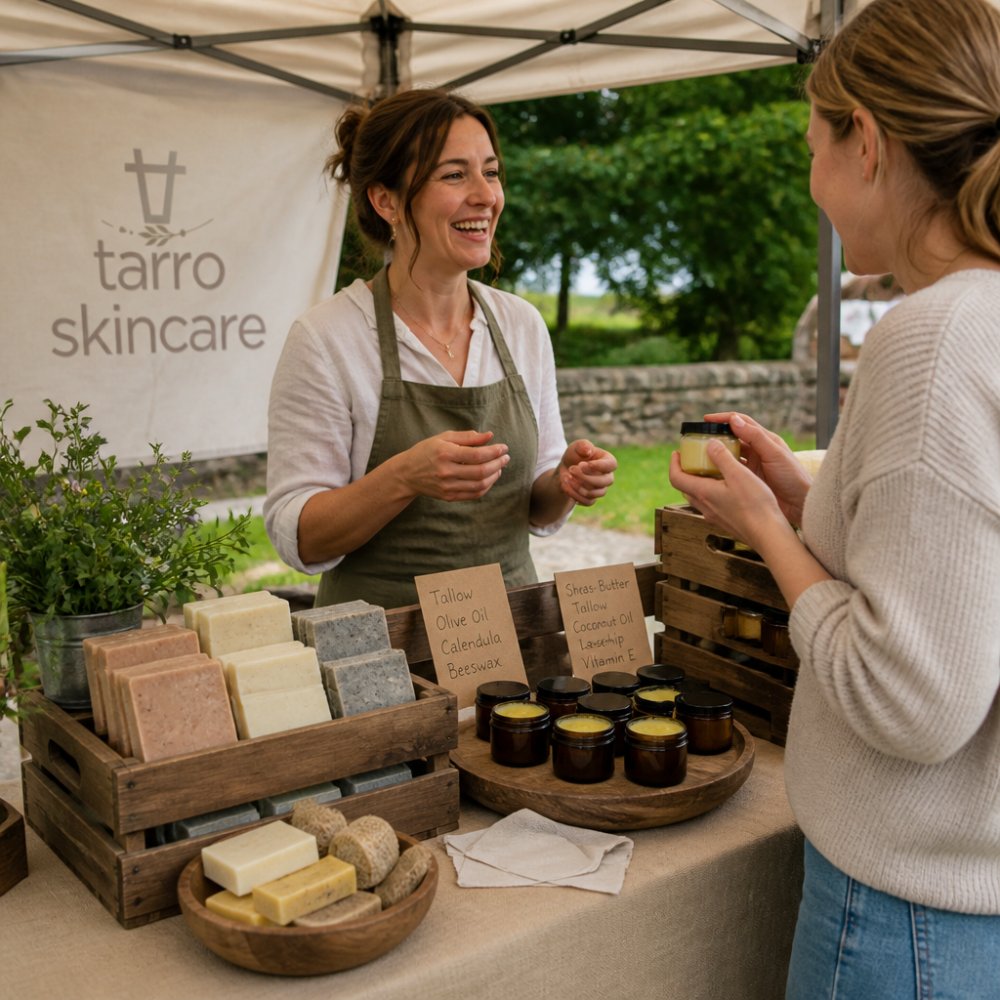
Go early: makers are less rushed before the crowd arrives, and the best batches sell out. Bring cash, since many small producers run card readers with patchy signal. A stall with no ingredient list on display is a red flag, cosmetics sold in Great Britain must carry a responsible person's details and a full ingredient declaration.
Why Grass-Fed Tallow Skincare Sits at the Centre of the Farm-Made Shelf
If you want the evidence on whether grass-fed tallow genuinely suits skin, our guide to grass-fed tallow for skin covers the barrier-support argument in detail.
Traceable Skincare Ingredients: What Proof Should You Ask For?
Traceable skincare ingredients are ingredients whose origin you can follow from finished product back to a named supplier, and the proof is documentary rather than decorative. Distinguish between an ingredient grown on a farm, a product made on a farm, and a brand that simply uses farm-sourced ingredients somewhere in the formula.
Ask for five things:
- A named farm or supplier, not a region. 'British tallow' is a category; 'pasture-fed tallow from a named holding in the Yorkshire Dales' is a supply chain.
- A batch code on the tin that matches the maker's records. A batch code that changes with every pour is a good sign; a single code printed across a whole year is not.
- A full ingredient list using INCI names, so you can see whether 'tallow' means Adeps Bovis or a blend, and whether the botanical oils are named or hidden behind 'parfum'.
- A responsible person's details on the label, which is a legal requirement for cosmetics sold in Great Britain. The name and address must be UK-based, and that person is accountable for the product safety file.
- A product safety report reference, which the responsible person must hold before the product is placed on the market. You will not usually see it on the label, but a serious maker can confirm it exists.
The UK government guidance on cosmetic product safety sets out what a compliant label must show, and it applies to homemade sellers as much as to large brands.
How to Tell a Named Supplier From a Farm Story
A useful test is to ask what the farm supplies besides the skincare ingredient. A tallow balm maker buying from a beef farm should be able to say where the meat goes. A honey soap maker should be able to say whether the honey is from their own hives or a neighbouring beekeeper. If the answer is vague, the farm relationship is probably a sourcing arrangement rather than a supply chain.
What Seasonality Tells You About Provenance
If a maker cannot answer the five questions above, the product may still be perfectly good skincare, but you are buying a formula, not a verified farm supply chain.
Tallow Balm vs Plant-Based Skincare: Which Suits Your Skin?
Tallow's advantage is biochemical similarity. For a deeper comparison of tallow versus plant-based moisturizers for face, the differences in fatty acids and occlusivity matter most. Its fatty acid profile is close to sebum, so it absorbs gradually and forms a soft protective layer. Plant oils bring linoleic acid and tocopherols, which many people with oilier or reactive skin prefer.
Where Plant-Based Skincare Fits in a Farm-Made Routine
Plant-based skincare earns its place in a farm-made routine as the supporting cast: a plant oil to balance texture, a botanical infusion for scent, a clay for cleansing. Most good ranges blend tallow with jojoba, olive, argan or sweet almond to adjust how the balm feels.
| Your situation | Better starting point | Why |
|---|---|---|
| Dry, tight, mature skin | Tallow balm | Fatty acids close to sebum, rich occlusive layer |
| Oily or easily congested skin | Plant-based oil or light balm | Lower occlusivity, higher linoleic content |
| Fragrance sensitivity | Unscented tallow balm | Short ingredient list, no essential oils |
| Vegan preference | Plant-based skincare | No animal-derived ingredients |
| Post-sauna or cold water | Barrier-repair balm | Seals moisture after transepidermal water loss |
Build Your Farm-Made Starter Set With Tarro
Our entry point is Bare Skin Balm at £10.00, a no-water, no-fragrance tallow balm with pasture-fed British tallow, jojoba, olive oil, olive squalane and beeswax. Apply it to the face, body or hands. Pair it with the unscented Bare Skin Bar at £9.00 if you want a fragrance-free cleanse, or Calm Balm at £10.00.

Tarro offers traceable tallow and plant-based skincare, including balms, soaps, deodorants and scrubs. Its lipid-rich formulations support the skin's natural barrier and help it retain moisture.
Get started with Tarro and build a farm-made routine you can trace back to the field.
Frequently Asked Questions
What does farm made skincare mean?
Farm made skincare can refer to products made using ingredients sourced from farms. Tarro partners with British farms to source tallow, milk, honey and botanicals.
How can I tell whether skincare ingredients are traceable?
Ask the maker where the ingredients came from and whether they can provide information about their source.
Is tallow skincare suitable for sensitive skin?
Tarro's Calm Balm is an unscented face and body balm made with tallow and argan oil. The product listing describes it as suitable for sensitive or easily irritated skin. If you have a diagnosed skin condition, check with your GP before switching products.
Where can I buy farm made skincare online?
Tarro's product listings include tallow balms, soaps and lip balms. The Unscented Lip Balm is £5.00, and the face and body balms listed here are £10.00.
How do I choose a small-batch natural skincare brand?
Review the ingredient list and ask the maker about ingredient sourcing if you have questions.


