

Tallow vs Plant-Based Moisturizers for Face
Last Updated: October 26, 2026
Quick Summary
The tallow vs plant-based choice comes down to which lipid mix your skin recognises and uses most readily, and neither is universally superior. Tallow is rich in oleic, palmitic and stearic acids similar to human sebum, while plant-based moisturizers draw on botanical oils, butters and waxes. The finished formula matters more than the hero ingredient.
- Tallow acts mainly as an emollient and occlusive, slowing water loss with a surface lipid layer.
- Plant-based creams can add humectants like glycerin and hyaluronic acid that draw water into skin.
- A pure tallow or plant-oil balm supplies fatty acids but not ceramides or cholesterol.
- Patch test any new balm on the jawline for 3 to 5 days before the full face.
- Many people use a tallow balm at night and a lighter plant oil in the morning.
Table of Contents
- Tallow vs Plant-Based Moisturizers for Face: The Core Difference
- Ingredient Sources and Composition Compared
- Fatty Acid Profiles and Skin-Lipid Similarity
- Hydration, Moisture Retention, and Barrier Support
- Is Tallow Good for Sensitive Skin?
- Does Tallow Clog Pores? Acne-Prone Skin and Comedogenicity
- Tallow Moisturiser Benefits and Drawbacks
- Best Moisturiser for Dry Facial Skin: Choosing Between the Two
- Frequently Asked Questions
Tallow vs Plant-Based Moisturizers for Face: The Core Difference
The tallow vs plant-based moisturizers for face debate comes down to one question: which lipid mix your skin recognises and uses most readily.
Tallow is rendered animal fat, typically from pasture-fed cattle, and it is rich in the same fatty acids found in human sebum. Plant-based moisturizers draw on botanical oils, butters and waxes instead.
Below, we break down composition, fatty acid profiles, barrier support, pore-clogging risk and how to choose between the two for your face. For the same comparison applied specifically to dry, sensitive skin, read our tallow vs plant-based moisturisers for dry, sensitive skin.
Ingredient Sources and Composition Compared
Tallow and plant-based moisturizers differ at the source before they differ on the skin. Tallow comes from rendered animal fat, while plant-based formulas rely on seed oils, fruit oils and plant butters.
Rendered Animal Fat vs Botanical Oils and Butters
Tallow is fat rendered from cattle, usually suet, then filtered.
Plant-based moisturizers use a wider raw material base: olive, jojoba, rosehip, sweet almond, shea, coconut and countless others. To see a plant-based balm built from five skin-loving oils, view Fresh Face.
The practical difference is formulation control. A single-ingredient tallow balm is simple and easy to read. A plant-based moisturizer can be tuned with lighter oils, emulsifiers and humectants to suit oilier or more reactive skin.
Fatty Acid Profiles and Skin-Lipid Similarity
Tallow's main selling point is fatty acid similarity to human sebum. Tallow is rich in oleic, palmitic and stearic acids, and that combination is what people mean when they call its structure bioidentical.
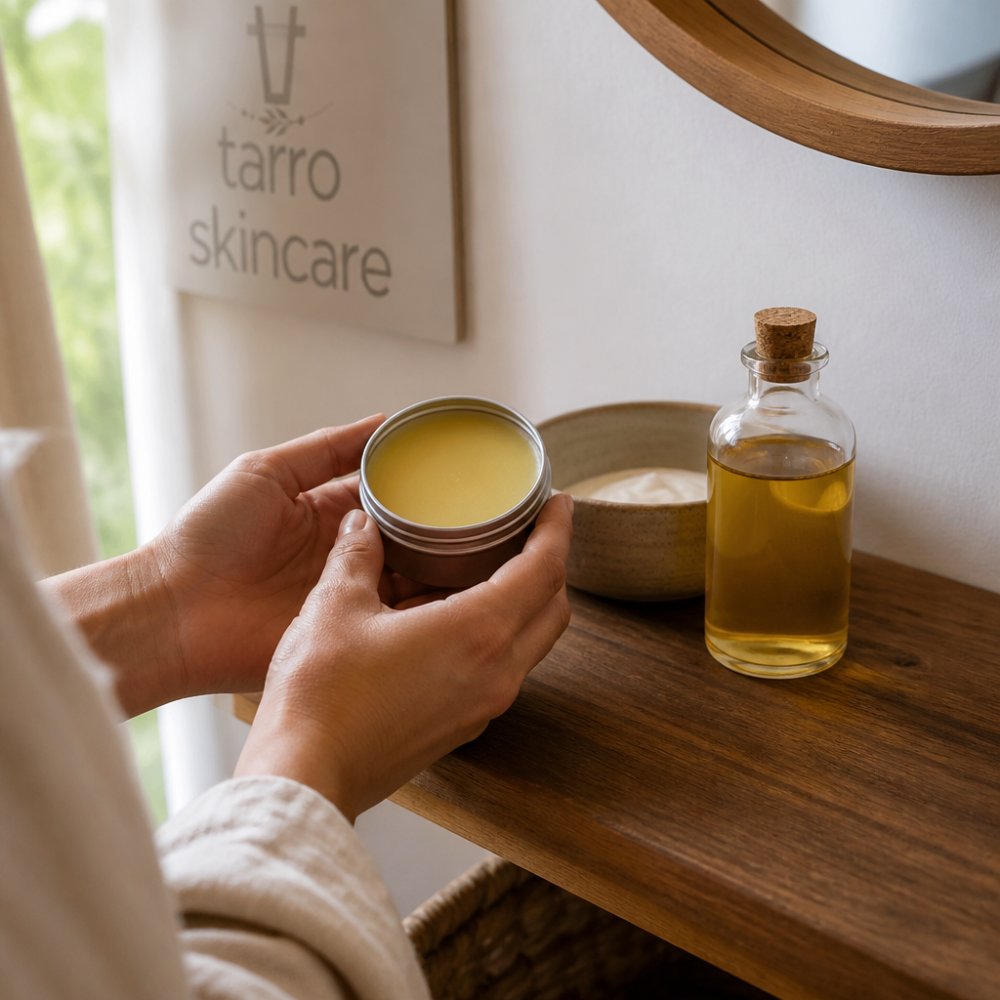
Plant oils vary enormously here. Jojoba is a liquid wax ester with a structure unusually close to human sebum. Rosehip is high in linoleic and oleic acid.
Similarity to sebum is a plausible reason a lipid absorbs well. It is not proof of superiority.
Hydration, Moisture Retention, and Barrier Support
Both categories support the moisture barrier by different mechanisms, and the finished formula matters more than the hero ingredient. Tallow acts mainly as an emollient and occlusive, softening skin and slowing transepidermal water loss with a surface lipid layer.
That distinction matters: tight, rough skin needs an occlusive balm to seal in moisture, while dehydrated, dull skin may do better with a humectant-led formula.
The Complete-Formula Comparison Competitors Skip
Most comparisons treat tallow and plant oils as standalone equivalents, but a finished facial moisturiser is a system. A typical plant-based cream contains:
- Humectants (glycerin, sodium hyaluronate, betaine) to pull water into the stratum corneum
- Emollients (plant oils, esters, squalane) to soften and smooth
- Occlusives (butters, waxes, dimethicone) to reduce water loss
An anhydrous tallow balm contains no water, so it needs no preservative or emulsifier, hence its short ingredient list. That simplicity suits reactive skin, but it means a tallow balm cannot deliver water-soluble humectants or sunscreen filters in the same product. A plant-based cream can, at the cost of a longer list and more potential triggers.
Barrier Repair: What the Fatty Acids Actually Do
Barrier repair is where tallow's fatty acid profile earns its reputation. Oleic, palmitic and stearic acids are raw materials skin uses to rebuild its lipid matrix, alongside ceramides and cholesterol.
Barrier repair is not just about adding fat: the lipid matrix needs ceramides, cholesterol and free fatty acids in roughly balanced proportions. A pure tallow or plant-oil balm supplies fatty acids but not ceramides or cholesterol, so it supports the barrier rather than fully rebuilding it.
Watch Out
Applying a heavy balm to damp, uncleansed skin traps irritants and can leave the face feeling greasy rather than comfortable. Cleanse first, then apply to slightly damp skin so any humectant can bind water before the occlusive layer goes on top.
Matching the Mechanism to Your Skin
| Skin behaviour | Mechanism that helps most | Example format |
|---|---|---|
| Tight, rough, flaky | Occlusive + emollient | Anhydrous tallow or plant-butter balm |
| Tight but also oily | Humectant + light emollient | Gel-cream or light plant-oil serum |
| Reactive, sting-prone | Short ingredient list, no fragrance | Plain fragrance-free balm |
| Daytime, sun-exposed | Humectant + emollient + SPF | Plant-based day cream with filters |
The takeaway: neither category wins on hydration by default, the winning formula is the one whose humectant, emollient and occlusive balance matches what your skin is missing.
Is Tallow Good for Sensitive Skin?
Tallow can suit sensitive skin, but it is not automatically gentler than a plant-based option. Sensitivity is usually about specific ingredients, fragrance and actives, not whether the base is animal or botanical.
Plain, fragrance-free tallow has a short ingredient list, which lowers the odds of hitting a trigger. Our Bare Skin Balm is built on exactly that logic. If you want the fuller picture on reactive and mature skin, this science-based guide to tallow for mature skin goes deeper.

Here is where we push back on the marketing.
Patch test any new balm on the jawline for a few days before committing to the full face.
Does Tallow Clog Pores? Acne-Prone Skin and Comedogenicity
Tallow is not inherently comedogenic, but it is not the safest choice for every acne-prone face either. Comedogenicity depends on the full formula, each oil's concentration and your own skin, not the word "tallow" alone.
Why a Single Comedogenicity Rating Misleads
Comedogenicity scales (such as the rabbit-ear assay) rate individual ingredients in isolation, often at 100% concentration.
The real risk factors are the supporting ingredients and their concentration. Coconut oil, cocoa butter and heavy waxes rank higher on comedogenicity scales, and several tallow balms lean on them for texture. A lean tallow-and-jojoba formula behaves quite differently from a rich, wax-heavy one.
Individual Response: What the Evidence Actually Supports
No high-quality trial predicts who will break out from a given tallow or plant-based moisturiser. Response depends on sebum composition, follicular anatomy, hormones, concurrent actives and the rest of your routine. Oily, congestion-prone skin often does better with lighter, linoleic-rich plant oils, while dry, barrier-impaired skin tolerates richer occlusives, but variation is wide, which is why trial sizes exist.
Face-Specific Application Guidance
If you are acne-prone and want to try either category, use this practical framework:
- Patch test first. Apply a thin layer to the jawline or a small area beside the nose for 3-5 days before using it on the full face. Stop if you see new papules, pustules or persistent redness.
- Use a thin layer, not a mask. A pea-sized amount warmed between fingertips is enough for the full face. Occlusive balms applied thickly can trap sweat and sebum.
- Frequency matters. Start with two or three nights a week rather than nightly, and build up only if your skin stays clear.
- Layer correctly. Apply after cleansing and any water-based serums, on slightly damp skin, and before sunscreen in the morning.
- Target dry patches. If you have combination skin, use a rich balm only on dry areas (cheeks, around the mouth) rather than all over.
- Know when to stop. If congestion appears within two weeks, discontinue and return to a lighter product. Persistent acne, painful nodules or scarring warrants a dermatologist's advice.
Pro Tip
If you are using prescription retinoids or exfoliating acids, your barrier may be more permeable and your skin more reactive. Introduce any new balm or oil one at a time, and avoid layering it over actives on the same night until you know how your skin responds.
Practical Shortlist for Acne-Prone Skin
- Lower-risk starting points: squalane, jojoba, rosehip, sunflower and other linoleic-rich plant oils in lightweight bases; plain fragrance-free tallow balms used sparingly on dry patches.
- Higher-risk formats: coconut-oil-heavy balms, cocoa-butter-rich creams, wax-heavy salves and anything with added fragrance or essential oils.
- Always check: the full ingredient list, not just the hero ingredient, and whether the product is labelled non-comedogenic (a marketing claim, not a clinical guarantee).
Individual response varies widely: what suits one face can congest another, which is why patch testing matters and why the most useful evidence is your own skin's response over two to four weeks, not a single ingredient rating.
Tallow Moisturiser Benefits and Drawbacks
Tallow moisturiser benefits are real but narrower than the trend suggests.
The drawbacks are equally real:
- Texture: tallow balms can feel rich and slow to absorb, especially in warm weather
- Scent: unrefined tallow carries a natural scent some people dislike
- Sourcing: quality depends on the farm and the rendering process
If the benefits convince you, our Glow Skin Balm is the simplest place to start. If you would rather stay botanical, skip ahead to the next section.

Best for: dry, mature or barrier-impaired skin that tolerates rich textures. Skip if: you have active acne or dislike a heavy feel on the face.
Best Moisturiser for Dry Facial Skin: Choosing Between the Two
The best moisturiser for dry facial skin matches your skin's behaviour, not the loudest claims.
Use this as a starting framework:
| Your skin situation | Better starting point | Why |
|---|---|---|
| Dry, tight, flaky | Tallow balm | Occlusive, sebum-like fatty acids |
| Dehydrated but oily | Plant-based facial oil | Lighter, dry-finish absorption |
| Sensitive and reactive | Fragrance-free tallow balm | Short ingredient list |
| Acne-prone | Light plant oil, thin layer | Lower comedogenic risk |
| Mature, sun-exposed | Rosehip and jojoba oil | Linoleic-rich, lightweight |
If you are leaning plant-based, our Ray Drop Facial Oil is designed for mature, dry or sun-exposed skin.

The tallow vs plant-based decision is not permanent. Many people use a tallow balm at night and a lighter plant oil in the morning, which captures the strengths of both without the heaviness.
Frequently Asked Questions
Why don't dermatologists like tallow?
Dermatologists tend to favour moisturisers with extensive clinical testing and added ingredients such as ceramides or humectants. A literature search through August 2026 found no high-quality human clinical trial testing plain beef tallow as an everyday facial moisturiser, so superiority over plant-based options has not been proven. That does not mean tallow is harmful. It means the evidence base is thinner than the wellness trend suggests, and individual response varies.
Is tallow good for sensitive skin?
It can suit sensitive skin because tallow is rich in fatty acids that mirror the skin's own lipid profile, and simple formulas without fragrance reduce irritation triggers. Tarro's Bare Skin Balm is no-water and no-fragrance, which helps if your skin reacts to essential oils. Patch test on your inner arm for a few days first, and introduce one product at a time so you can identify what causes a reaction.
Does tallow clog pores or cause breakouts?
Tallow is an occlusive, lipid-rich ingredient, so on acne-prone or oily skin it can feel heavy and may contribute to congestion if applied too thickly. Much depends on the complete formula and your individual skin type. If you are prone to breakouts, use a small amount on dry areas only, or choose a lighter plant-based option such as Tarro's Ray Drop Facial Oil, which is built on rosehip and jojoba.
Can you use tallow and plant oils together on your face?
Yes. Many tallow balms already combine rendered fat with plant oils: Tarro's Bare Skin Balm pairs tallow with jojoba, olive oil, and olive squalane. Layering works too. Apply a plant-based oil or mist first, then seal with a thin layer of tallow balm to slow moisture loss. This gives you the lipid support of tallow with the lighter texture and slip that plant oils provide.
Is tallow or plant-based moisturiser better for dry facial skin?
For very dry or barrier-impaired skin, tallow balms tend to feel more occlusive and longer-lasting because of their dense fatty acid content. Plant-based oils such as rosehip and jojoba absorb faster and suit those who dislike a rich feel. There is no proven winner in the research. Match the choice to your skin type, texture preference, and how much occlusion your skin needs, especially around the eyes and cheeks.
The tallow vs plant-based moisturizers for face question has no single winner, and any brand telling you otherwise is selling, not advising. What we would say is this: start with your skin's behaviour, not the trend. Tarro makes both sides of this comparison, with traceable grass-fed tallow balms that support the skin barrier and plant-based oils built on rosehip and jojoba. Explore the range and find the texture your face actually wants.


