

Tallow Balm for Eczema-Prone Skin: What to Know
Quick Summary
A tallow balm is a solid skincare product made from rendered beef fat, usually blended with a few plant oils or beeswax. It can help dry skin feel softer, but it does not treat eczema, so speak to a GP or dermatologist about eczema care.
- Tallow is rich in oleic and palmitic acid, fatty acids that are also part of the skin's own lipid layer.
- Some research suggests tallow has a moisturising effect on skin.
- Choose short ingredient lists and avoid fragrance and essential oils if your skin is reactive.
- Patch test a new balm on a small area for 24 to 48 hours before wider use.
- Stop using the balm and seek advice if you notice spreading redness, weeping or signs of infection.
Table of Contents
- What Tallow Balm Is and How It Is Made
- What the Evidence Says About Beef Tallow for Eczema
- Tallow Balm Ingredients to Check on the Label
- Tallow Balm Side Effects and Who Should Be Cautious
- How to Patch Test a Tallow Balm Before Full Use
- Applying Tallow Balm to Dry or Flaring Skin
- Choosing Your Next Step: Trying Tarro's Calm Balm
- Frequently Asked Questions
What Tallow Balm Is and How It Is Made
A tallow balm is a skincare product built around rendered beef fat, which is melted down, filtered and usually blended with a small number of plant oils or beeswax.
Tallow is rich in fatty acids such as oleic and palmitic acid, which is why it feels so substantial on the skin. If you are comparing labels before you buy, this guide to buying grass-fed tallow balm online explains what to look for.
Tallow balm is a solid, spreadable product that melts on contact with warm skin and forms a soft protective layer.
The method matters as much as the ingredient. Good rendering removes impurities and gives a cleaner, more consistent base.
What the Evidence Says About Beef Tallow for Eczema
This is where the marketing and the science part ways, so it is worth being direct.
The picture is more encouraging on basic moisturising. Some research suggests tallow can have a moisturising effect on skin.
Mouse studies do not translate directly to people, so any animal research on tallow should be treated as a reason for further research, not proof.
The honest summary is that tallow may help dry, uncomfortable skin feel softer, but it should not be seen as a treatment for eczema.
Tallow Balm Ingredients to Check on the Label
A short ingredient list is one of the most useful things you can check. Fewer ingredients mean fewer chances of a reaction, and it is easier to see what you are actually applying.
Look for these on the label:
- Adeps Bovis (tallow): the main ingredient, and the one to confirm is grass-fed
- Plant oils: such as jojoba, olive or argan, which add texture and softness
- Beeswax: gives a protective, breathable finish
Compare this with a longer list. Each extra ingredient is another possible irritant, which matters if you have sensitive or reactive skin. Bare Skin Balm uses tallow, jojoba, olive fruit oil, olive-derived squalane and beeswax, with no added fragrance.
Fragrance, essential oils and other common irritants
Fragrance and essential oils are the most common causes of irritation in balms, even in products sold as natural. If you want a simple, single-purpose balm formulated for sensitive skin, see Bare Skin Balm.

If your skin reacts easily, choose an unscented balm and check the label for "fragrance", "parfum" and essential oils. Calm Balm and Bare Skin Balm are both fragrance-free.
Tallow Balm Side Effects and Who Should Be Cautious
Tallow is an animal-derived ingredient, so reactions are possible even in a simple formula. Most people tolerate it well, but a balm is not risk-free, and the risk depends heavily on what else is in the tin. Rather than relying on words like "natural" or "gentle", assess each ingredient on the label.
Ingredient-by-ingredient risk assessment
- Tallow (Adeps Bovis): Generally well tolerated, but anyone with a known beef or mammal-meat allergy should avoid it. Very reactive or broken skin can sting on contact.
- Fragrance and parfum: The most common cause of cosmetic contact allergy. Avoid entirely if your skin is inflamed or you have reacted to scented products before.
- Essential oils (lavender, citrus, tea tree, cedarwood, peppermint): Natural does not mean non-irritant. These can redden, sting or sensitise eczema-prone skin, and citrus oils are also phototoxic.
Who should be especially cautious
- Anyone with a known allergy to beef, animal fats, lanolin, bee products or specific botanicals
- People with very reactive, broken, weeping or infected skin
- Those using a prescription topical treatment (for example a topical corticosteroid or calcineurin inhibitor), a balm should not replace it, and applying thick balms over some prescriptions can affect absorption, so follow the prescriber's advice
- Parents or carers applying balm to a child with eczema, where skin is often thinner and more reactive
Red flags: stop and seek advice
Stop using the balm and speak to a GP or pharmacist if you notice:
- Spreading redness, swelling, warmth or pain
- Weeping, crusting, yellow or green discharge, or a bad smell, possible signs of infection
- New blistering, hives or a rash that extends beyond where you applied the product
- Itching or irritation that worsens rather than settles within a few days
Watch Out
A balm is a moisturiser, not a treatment for eczema. If your eczema is severe, infected, persistent or getting worse despite regular emollient use, seek medical advice rather than layering on more balm.
How balm fits alongside standard care
Emollients are a cornerstone of eczema care, and a plain, fragrance-free balm can sit within that routine. Apply prescribed treatments as directed, usually before or after emollient depending on the product, and do not stop or reduce a prescription without advice.
The table below sums up the main ingredient-level risks discussed in this section, so you can check a balm's label quickly.
| Ingredient | Risk | What to do |
|---|---|---|
| Tallow (Adeps Bovis) | Generally well tolerated; avoid if allergic to beef | Check for known beef or mammal-meat allergy |
| Fragrance and parfum | Most common cause of cosmetic contact allergy | Avoid if skin is inflamed or reacts to scents |
| Essential oils | Can redden, sting or sensitise; citrus is phototoxic | Choose unscented balms |
| Honey and bee-derived ingredients | Can irritate broken skin; bee products may trigger reactions | Avoid if sensitive to bee products |
| Lanolin | Recognised contact allergen for a minority | Avoid if known allergy |
| Preservatives | Water-containing creams carry higher sensitisation risk | Anhydrous balms often need none |
How to Patch Test a Tallow Balm Before Full Use
A patch test is the simplest way to find out whether a balm suits you. Do it before using a new product all over.
- Choose a small area of skin, such as the inside of your forearm or behind the ear.
- Clean the area with water and pat it dry.
- Apply a pea-sized amount of balm.
- Leave it alone for 24 to 48 hours, washing the area only with water.
- Check for redness, itching, bumps or swelling.
If the area stays calm, you can move on to a larger patch. If anything develops, stop and do not use the product on your face or on flare-prone areas.
Applying Tallow Balm to Dry or Flaring Skin
Application technique matters as much as the product. A balm works best on clean, slightly damp skin, because water trapped under the occlusive layer is what actually hydrates. The aim is a thin, even film, not a thick scoop.
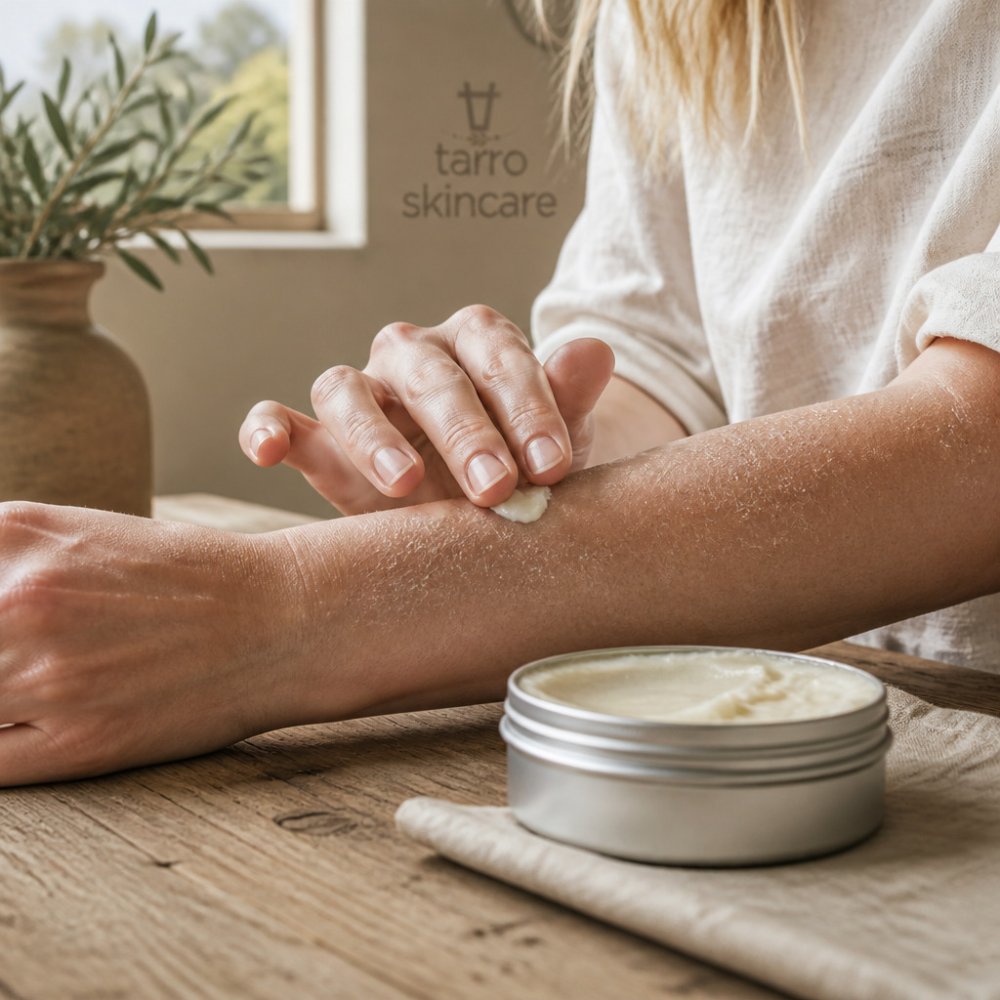
Step by step
- Wash hands with soap and water and dry them before touching the tin or your skin.
- Cleanse gently with a fragrance-free emollient wash or plain water, then pat, do not rub, semi-dry.
- Warm a pea-sized amount between clean fingertips until it turns from solid to oil.
- Press and smooth over the area in the direction of hair growth rather than rubbing hard, which can aggravate inflamed skin.
- Reapply to hands, elbows, feet and lips as needed through the day, and after washing or water exposure.
How much to use
A pea-sized amount is a good starting point. For larger areas, use a little more, but build up rather than starting thick.
Applying during a flare
During an active flare, skin is more permeable and more reactive. For a closer look at how tallow balm absorbs and behaves on dry skin, see how tallow balm absorbs into dry skin. Keep the routine minimal: use a plain, fragrance-free balm, apply to damp skin, and avoid layering multiple new products at once so you can tell what is helping.
Hygiene, storage and shelf life
- Decant, don't dig: use a clean spatula or the back of a clean nail to take product from the tin, or keep a smaller tin for daily use and refill from a larger one.
- Keep fingers out of a shared tin where possible, especially if skin is broken or infected.
- Store below 25°C, away from direct sunlight and radiators. Tallow softens in warmth; extreme heat can affect texture and stability.
- Keep water out: anhydrous balms are self-preserving, but introducing water (wet fingers, a damp bathroom shelf) can allow microbial growth.
Pro Tip
If you use a prescription topical treatment, ask your pharmacist how to sequence it with an emollient balm. A common approach is to apply the prescription first, wait as directed, then apply balm, but follow the specific advice for your product.
Fitting balm into a routine
Apply balm after bathing while skin is still damp, and again before bed for overnight occlusion. For hands, keep a small tin by the sink and reapply after washing. For feet, apply a thin layer before socks. Consistency matters more than quantity: regular, thin applications generally work better than occasional thick ones.
Choosing Your Next Step: Trying Tarro's Calm Balm
If you want to try a tallow balm, start with a simple, fragrance-free option and patch test first. Calm Balm is a good place to begin, as it contains just two ingredients: grass-fed tallow and argan oil.
If you want to try a few balms before choosing a favourite, the Tallow Balm Bundle brings together three Tarro balms for £25.00. For a balm at home and one to take with you, the Little and Large Balm Bundle pairs one 80g and one 30g balm for £26.00.
Whatever you choose, check the ingredients, patch test first, and speak to your GP or dermatologist if your eczema is not settling. A balm can make dry skin more comfortable, but it is not a replacement for proper medical care.
Frequently Asked Questions
Can tallow balm cure eczema?
No. Evidence does not show that tallow balm cures eczema or treats the immune activity behind it. It may help dry skin feel softer, but speak to a GP or dermatologist about eczema treatment.
Is tallow balm safe for sensitive skin?
It can be, especially if it is simple and fragrance-free. However, tallow is animal-derived, so some people may react. Always patch test first.
How long should I wait before deciding if a balm works?
Give it a few weeks of regular use on the same area. Stop straight away if you develop redness, swelling or spreading itch.
Frequently Asked Questions
Can you use tallow balm on eczema-prone skin?
Many people with eczema-prone skin use tallow balm as a plain moisturiser, and it is a lipid-rich, fragrance-free option when the ingredient list is short. Tallow is animal-derived, though, and can cause allergic reactions or worsen sensitivity in some people. Patch test on a small area for several days before using it more widely. If your eczema is active, inflamed or weeping, speak to your GP or a pharmacist before relying on any balm, as standard prescribed treatments remain the first line of care.
Does beef tallow help eczema?
The evidence is limited. Research on tallow's moisturising effects is limited, and the evidence does not currently support tallow as a treatment for dermatologic conditions such as eczema. Tallow does not appear to address the immune response behind a flare, so it should be seen as a moisturiser that may help dryness, not a treatment for eczema.
Is tallow balm safe for sensitive skin?
For some people with sensitive skin, a simple tallow balm with no added fragrance or essential oils is well tolerated. For others, animal-derived fats can trigger reactions. The safest approach is to choose a short ingredient list, avoid added fragrance, and patch test first. Calm Balm from Tarro is unscented and contains only tallow and argan oil, which makes it easier to judge whether your skin tolerates it.
How do you patch test a tallow balm?
Apply a pea-sized amount to a small area of skin, such as the inner forearm or behind the ear, once a day for three to five days. Check for redness, itching, stinging, swelling or new bumps during and after each application. If nothing develops, you can try it on a larger area. Stop immediately if a reaction appears and wash the area with lukewarm water.


