

7 Signs You're Applying Tallow Balm at the Wrong Time
Last Updated: November 17, 2026
Quick Summary
The best time to apply tallow balm is at the end of your routine, pressed over slightly damp skin after cleansing and any serums or moisturiser. Use it once or twice a day, either in the morning for dry or tight skin or at night for most skin types. Always apply sunscreen after tallow balm in the morning.
- Warm a pea-sized amount between fingertips until glossy, then press rather than rub it into skin.
- Apply tallow balm last in your routine, with sunscreen in the morning always after the balm.
- Once or twice a day is enough for most people, since more is not better with a water-free balm.
- A pea-sized amount covers the whole face, while a fingertip-sized amount handles arms and legs.
- Skip balm at night if you sleep hot and sweat, and use less in the morning under makeup.
Is your balm timing working against you?Tarro makes traceable grass-fed tallow balms for simple, comfortable skin.
Shop Tallow Balm
Table of Contents
- Why Timing Changes How Tallow Balm Works
- How to Use Tallow Balm for Skin That Feels Comfortable
- Tallow Balm Morning or Night: Which Slot Fits Your Routine
- Tallow Balm Before or After Moisturiser
- How Often to Use Tallow Balm Without Overloading Your Skin
- How Much Tallow Balm You Actually Need
- Checking Your Tallow Balm Is Traceable Before You Commit
- Building a Simple Balm Routine With Tarro
- Frequently Asked Questions
Why Timing Changes How Tallow Balm Works
The best time to apply tallow balm depends on what your skin is doing at that moment. For a closer look at how tallow balm absorbs into skin, the practical guide explains what happens after application.
A 2024 review of tallow biocompatibility published in PubMed Central raises the question of how well rendered animal fat suits human skin. It does not settle the question. That honesty matters here: good timing is a practical skill, not a magic trick.
How to Use Tallow Balm for Skin That Feels Comfortable
The core method is simple: warm it, press it in, and build it on a damp base. That sequence does more for comfort than any amount of product.
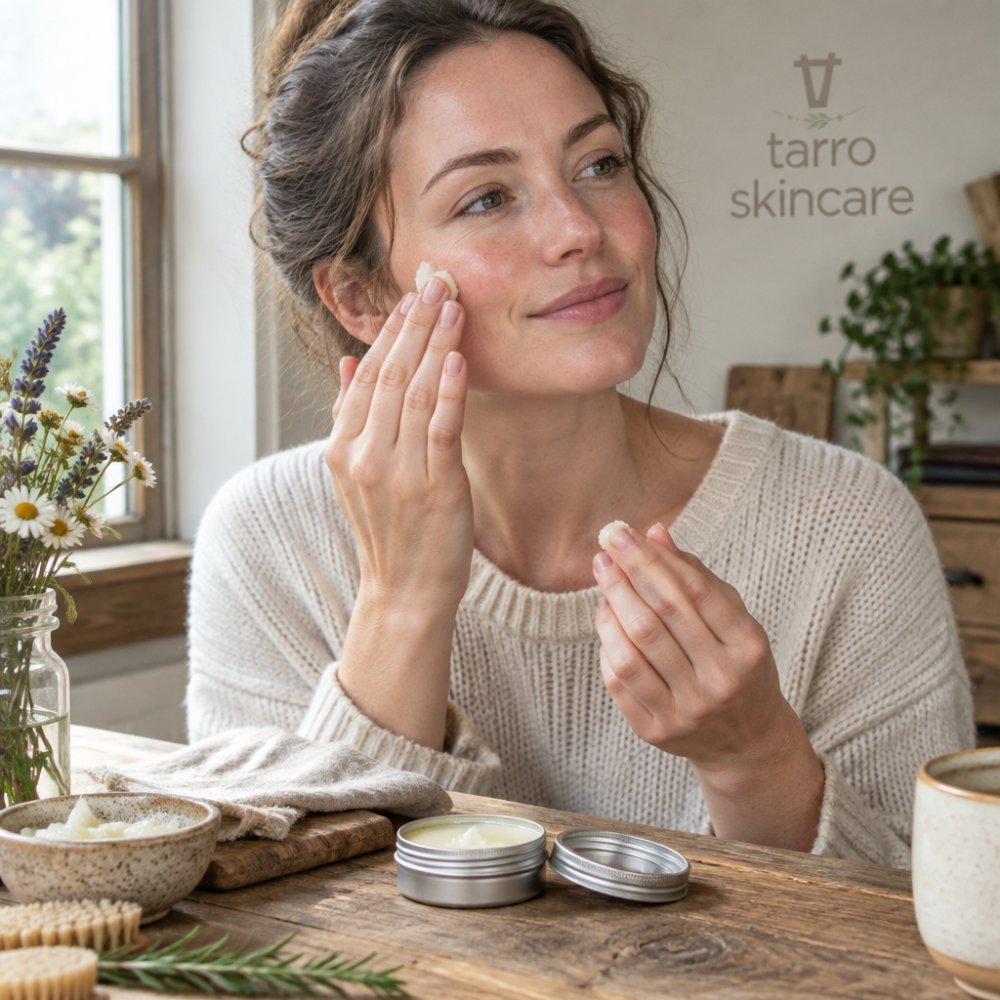
Warm It First, Then Press It In
Take a small amount between your fingertips and let body heat soften it for a few seconds. Then press, don't rub, so the balm meets the skin evenly instead of pooling in one spot.
- Scoop a pea-sized amount for the face
- Warm between clean fingertips until it turns glossy
- Press into cheeks, forehead and jaw, then the neck
- Use a fingertip-sized amount for arms and legs
Damp or Dry Skin: What Works Better
Damp skin is a practical starting point, since the balm can help seal in moisture already on the skin.
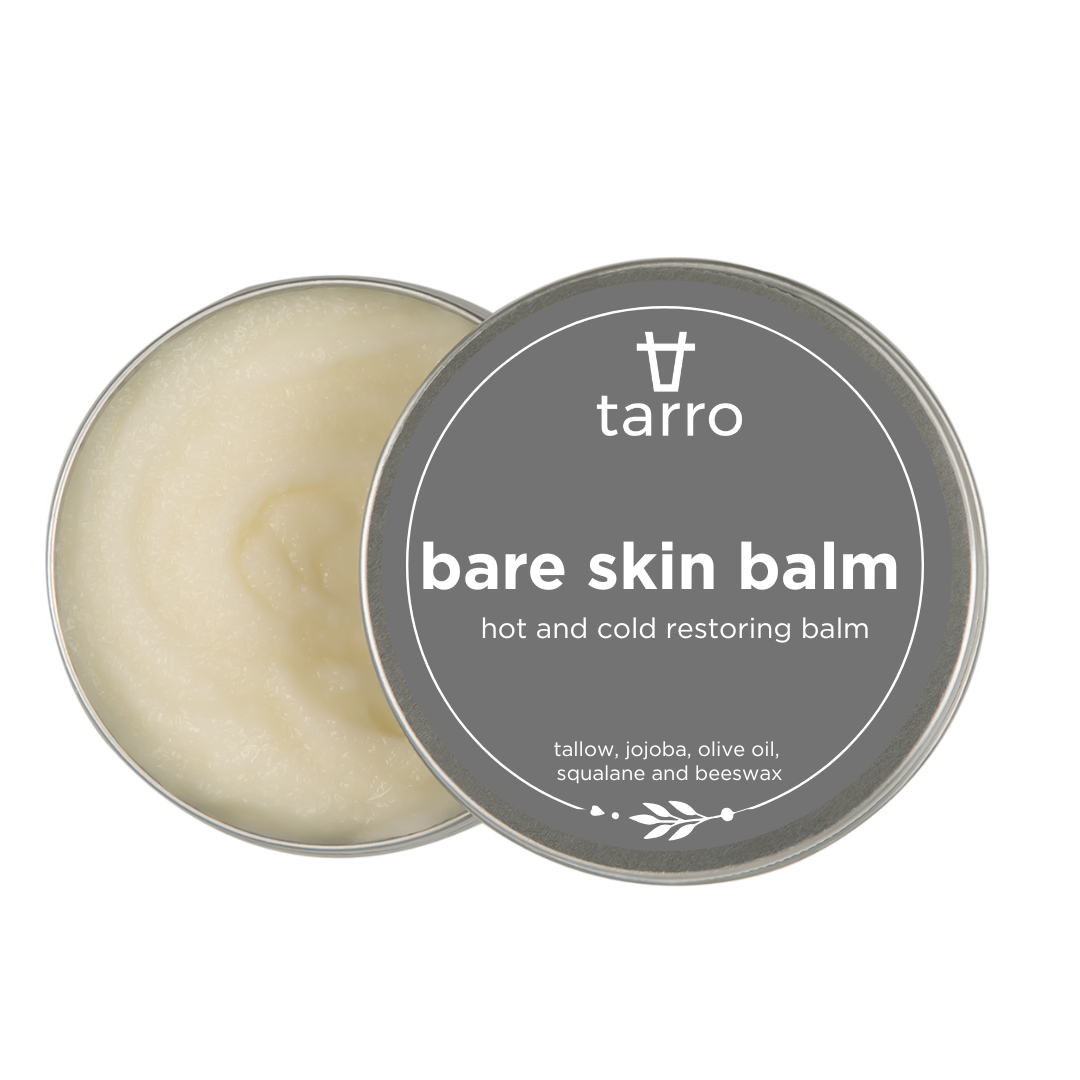
Pat your face dry after cleansing, leaving it slightly damp. Then press the balm over the top. For a more deliberate seal, apply a mist first and follow with the balm, which is exactly how our Bare Skin Balm is designed to be used.
Tallow Balm Morning or Night: Which Slot Fits Your Routine
Morning use suits drier skin types or cold weather, when skin feels tight after washing. In that case, use less and press it in well before makeup.
Here is how the two slots compare:
| Slot | Best for | Amount | Watch out |
|---|---|---|---|
| Morning | Dry or tight skin, cold weather | Very small, pea-sized | Too much under makeup can pill |
| Night | Most skin types, mature or dehydrated skin | Small to moderate | Skip if you sleep hot and sweat |
| Post-wash | Skin still damp from cleansing | Small | Don't apply to soaking wet skin |
The morning-or-night question comes down to your skin. If your face feels tight by mid-morning, try a lighter morning layer; if it feels comfortable all day, keep balm for night only.
Tallow Balm Before or After Moisturiser
After, in most routines. Tallow balm is an occlusive layer, so it belongs at the end of your skincare steps, not the start.
Water-based serums and moisturisers can go underneath, with the balm on top to help limit moisture loss from the skin's surface.
If you want the full order, our guide to layering balm with your skincare walks through each step.
- Serums and mists: first, on damp skin
- Light moisturiser: next, if you use one
- Tallow balm: last, pressed over the top
- Sunscreen: in the morning, always after the balm
How Often to Use Tallow Balm Without Overloading Your Skin
Once or twice a day is enough for most people. More is not better with a water-free balm.
How Much Tallow Balm You Actually Need
Less than you think. A pea-sized amount covers the whole face, and a fingertip-sized amount handles arms and legs.
For a precise breakdown by body area and skin type, our guide on how much balm to apply to your face gives practical amounts you can follow.
Checking Your Tallow Balm Is Traceable Before You Commit
A balm is only as good as the fat it is made from. But 'traceable' is a word brands use loosely. Before you buy, you need to know what proof actually looks like and how to ask for it without being fobbed off.
The gap between a marketing claim and a verifiable chain of custody is where your money either buys real quality or a story.
Here is a practical workflow you can run with any tallow balm brand, including ours.
Step 1: Ask for the farm, not the region
A claim like 'sourced from British farms' is not traceable; a named farm or supplier is. Ask directly: 'Which farm or group of farms supplies your tallow, and in which county are they?' A credible seller will answer with a name. If they cite commercial reasons, ask whether they can share it under a simple confidentiality agreement or point you to a certification that covers the supply chain.
Step 2: Request batch-level information
Traceability lives at batch level. Ask: 'Can you tell me which batch this tin came from, and can you link that batch to a specific farm and rendering date?' Look for a batch or lot code on the packaging. If there is none, the product cannot be traced beyond the brand's general claim. A seller who can provide a batch record, even a redacted one, is showing you a real system.
Step 3: Understand the chain of custody
Tallow passes through several hands: the farm, the abattoir or processor, the renderer, and the balm maker. A credible traceability claim connects these steps. Ask: 'Who renders your tallow, and can you show documentation linking the finished balm back to the farm?' You need not audit the whole chain yourself, but the seller should be able to describe it without gaps. If they cannot name the renderer, the chain is broken.
Step 4: Evaluate the evidence you are given
Not all proof is equal. Here is how to grade what a seller sends you:
- Farm name and county: a starting point, but not proof on its own.
- Supplier declaration: a signed statement from the farm or renderer. Useful, but only as reliable as the signatory.
- Invoices or delivery notes: stronger, because they show a real transaction. Check that the dates and quantities make sense for the volume of balm sold.
- Audit reports or certification documents: the strongest common evidence, provided you check the scope and validity. A certificate for 'organic' does not automatically cover animal welfare or grass-fed claims.
- Batch records: the gold standard for linking a specific tin to a specific farm and date.
Ask what each document can and cannot prove. An invoice proves a transaction happened, not that the cattle were grass-finished. A certification proves the standard was met at audit, not that every batch was compliant. Credible sellers will be honest about these limits.
Step 5: Check certifications properly
Confirm three things: the certificate is current, it covers the product you are buying, and the standard actually addresses the claim you care about. A certificate covering processing hygiene says nothing about the cattle's diet, not deception, but not proof of grass-fed sourcing either.
Step 6: Use a seller-question checklist
Copy this and send it to any brand you are considering:
- Which farm or farms supply your tallow, and where are they located?
- Are the cattle grass-fed or grass-finished, and what does that mean in your supply chain?
- Who renders the tallow, and can you describe the chain from farm to finished balm?
- Can you provide batch-level sourcing information for the tin I would receive?
- Which certifications do you hold, with the certifying body and certificate number?
- Can you share a supplier declaration or audit summary that covers animal diet and welfare?
A short message works well: 'Hello, I am interested in your tallow balm. Could you tell me which farm supplies your tallow, whether the cattle are grass-finished, and whether you can provide batch-level sourcing information? I would also appreciate details of any certifications, including the certifying body and number.' A seller with real traceability will answer without hesitation. One who dodges the question has told you something useful.
Red flags and evidence grading
Be wary of vague claims ('ethically sourced', 'local farms'), QR codes that lead to a generic homepage rather than batch data, and certificates that cannot be verified on the certifying body's register. None of these is proof of wrongdoing, but each is a gap in the evidence.
For a fuller set of checks, see our guide on verifying grass-fed tallow sourcing before you buy.
Building a Simple Balm Routine With Tarro
A good routine needs one or two products, not ten. But 'simple' does not mean 'vague'. Here is how to build a routine that works with any tallow balm, and how our own products fit into it.
Start with the three-step core
Every effective tallow balm routine has the same skeleton: cleanse, add water, seal. The balm is the seal. Everything else is optional. If you do nothing else, do this:
- Cleanse gently and pat dry, leaving skin slightly damp.
- Apply a mist or light serum if you use one.
- Warm a pea-sized amount of balm between fingertips and press it into face and neck as your final step.
That is the routine. It takes under two minutes. The variables are how often you do it and how much balm you use.
Match the balm to the job
Not every tallow balm suits every use. A dense, unwhipped balm suits drier areas, while a whipped balm spreads more easily. Fragrance-free formulas are available for those who prefer to avoid scent.
At Tarro, our balms are made with grass-fed tallow and a short list of plant oils. Calm Balm is fragrance-free, made with tallow, argan oil and Vitamin E. Cloud Cream is a whipped, lightweight tallow balm designed for evening use.
Adjust frequency to your skin, not the label
Scale back before you decide the product is not for you.
Keep the rest of the routine light
A common mistake is pairing a rich balm with a rich cream. Pick one occlusive step: if you use a heavy night cream, use the balm on alternate nights or only on dry patches; if the balm is your final step, keep the layers underneath light, a mist, a serum, perhaps a light lotion. The balm will do the sealing.
A sample week
- Monday to Friday: cleanse, mist, pea-sized balm at night. Morning: splash of water, light moisturiser, sunscreen. Balm only if skin feels tight.
- Saturday: exfoliate gently if your skin tolerates it, then balm on damp skin at night.
- Sunday: assess. If skin feels comfortable, continue. If not, reduce frequency or amount.
Tarro's formulations are made by a certified organic skincare formulator. Tarro does not use scare-mongering claims for natural skincare.
Frequently Asked Questions
When is the best time to apply tallow balm?
Applying tallow balm after cleansing, while skin is still slightly damp, is a practical approach, since the balm can help limit moisture loss from the surface. Cloud Cream is formulated for evening use. There is no single correct hour, so match the timing to when your skin feels dry.
Should you apply tallow balm to damp or dry skin?
Damp skin is a practical starting point. Tallow balm is water-free and can help limit moisture loss from the skin's surface. Pat skin rather than rubbing it fully dry, then warm the balm between your fingertips and press it in.
Can you leave tallow balm on overnight?
Cloud Cream is formulated for evening use, applied to the face and neck before bed. Each Tarro balm should be used within 12 months of opening.
How long does tallow balm take to absorb?
Whipped Glow Skin Balm has a whipped, airy texture, which suits anyone who finds a dense balm too rich.


