

Is Natural Farm-Made Dog Balm for Dry Paws Safe?
Last Updated: November 4, 2026
Quick Summary
A natural farm-made dog balm is safe for dry paws when every ingredient is food-grade or explicitly pet-safe and your dog cannot lick off large amounts. Avoid balms with fragrance, essential oils or zinc oxide, and apply a thin layer after walks.
- Apply a pea-sized amount of balm to clean, dry paws and distract your dog while it absorbs.
- Reapply dog paw balm two to three times a week, or daily in harsh weather.
- The DIY recipe makes about 135 g using 30 g beeswax, 60 g coconut oil, 30 g shea butter and 15 g olive oil.
- Deep cracks that bleed, swelling, limping or a bad smell need a vet, not balm.
- Store balm in a cool, dark cupboard in a sealed tin and discard it if the smell or texture changes.
Table of Contents
- Why Dry Paws Need a Balm, Not Just a Walk
- Is Paw Balm Safe for Dogs?
- Dog Paw Balm Ingredients: What to Look For and What to Avoid
- How to Use Dog Paw Balm Without the Mess
- A DIY Dog Paw Balm Recipe You Can Make in One Pan
- When Dry Paws Need a Vet, Not a Balm
- Choosing a Farm-Made Balm for Your Dog's Paws
- Frequently Asked Questions
Why Dry Paws Need a Balm, Not Just a Walk
A natural farm-made dog balm for dry paws does more than soften rough skin. It replaces the oils that daily walks strip away. Paw pads take a beating: hot tarmac in summer, gritted pavements in winter, and constant friction on every surface.
Most owners notice the problem too late. By the time pads look cracked, the damage has been building for weeks.
At Tarro, we make balms from grass-fed tallow and plant oils for human skin.
Here is what most guides get wrong: they treat balm as a cosmetic fix. It is not. A good balm is barrier repair.
Below, we explain how to use a dog balm safely, which ingredients to trust, and how to make your own.
Is Paw Balm Safe for Dogs?
Paw balm is safe for dogs when every ingredient is food-grade or explicitly pet-safe, and when the dog cannot lick off large amounts. The risk is rarely the balm base. It is the additives: essential oils, fragrance, preservatives and human skincare actives that are fine on human skin but not in a dog's mouth.
The same cannot be said for many plant oils that smell pleasant to us. Tea tree, eucalyptus, peppermint, wintergreen and citrus essential oils are common in human balms and are not appropriate for a dog's paws. Zinc oxide, often found in human nappy creams, is another one to avoid.
The PDSA guidance on harmful substances for dogs and the RSPCA advice on toxic substances both list common household items that harm dogs. Keep them handy when you shop, and treat any balm labelled 'fragrance' or 'parfum' as unsuitable unless the maker states exactly what it is.
The Lick Test: What Happens If They Groom It Off
A small amount of licked balm is normal and usually harmless. Beeswax, coconut oil and shea butter are all gentle in tiny quantities. The problem comes from volume and from additives.
Watch for these signs after application:
- Excessive licking or drooling
- Vomiting or loose stools
- Redness or swelling at the paw
- Restlessness or discomfort
If you see any of these, wipe the paws clean and call your vet. A common mistake is applying too much. A thin layer is enough, and a dog that is determined to lick should be distracted with a treat or a short play session while the balm sinks in.
How to judge an ingredient list:
- Fewer than about eight ingredients is a good sign; long lists usually mean preservatives and fragrance.
- Look for the word 'fragrance', 'parfum' or 'essential oil' without a named source, treat it as a no.
- Food-grade beeswax, coconut oil, shea butter, mango butter and olive oil are the safest everyday choices.
- Calendula and chamomile are generally gentle botanicals, but check the maker's guidance if your dog has known sensitivities.
- If your dog is on medication, pregnant, nursing or has a diagnosed skin condition, ask your vet before applying anything new.
Dog Paw Balm Ingredients: What to Look For and What to Avoid
Avoid anything with added fragrance or essential oils when choosing a balm.
For a full breakdown of why fat-rich balms suit skin, read our guide on whether tallow is good for your skin.
Ingredients worth having:
- Beeswax - forms a protective shield over the pad
- Coconut oil - moisturises and soothes
- Shea or mango butter - softens rough, cracked pads
- Olive or sweet almond oil - hydrates without heaviness
- Calendula - a gentle botanical for sensitive skin
Ingredients Worth Checking Twice
Some ingredients sound natural but are not dog-safe. Tea tree, eucalyptus, peppermint and citrus essential oils can upset a dog's system. Zinc oxide, often found in human nappy creams, is another one to avoid.
The RSPCA advice on toxic substances lists common household items that harm dogs. Keep it handy when you shop.
How to Use Dog Paw Balm Without the Mess
Apply dog paw balm to clean, dry paws using a thin layer, then distract your dog for a few minutes so it absorbs. That is the whole method. The mess comes from over-application, not the balm.
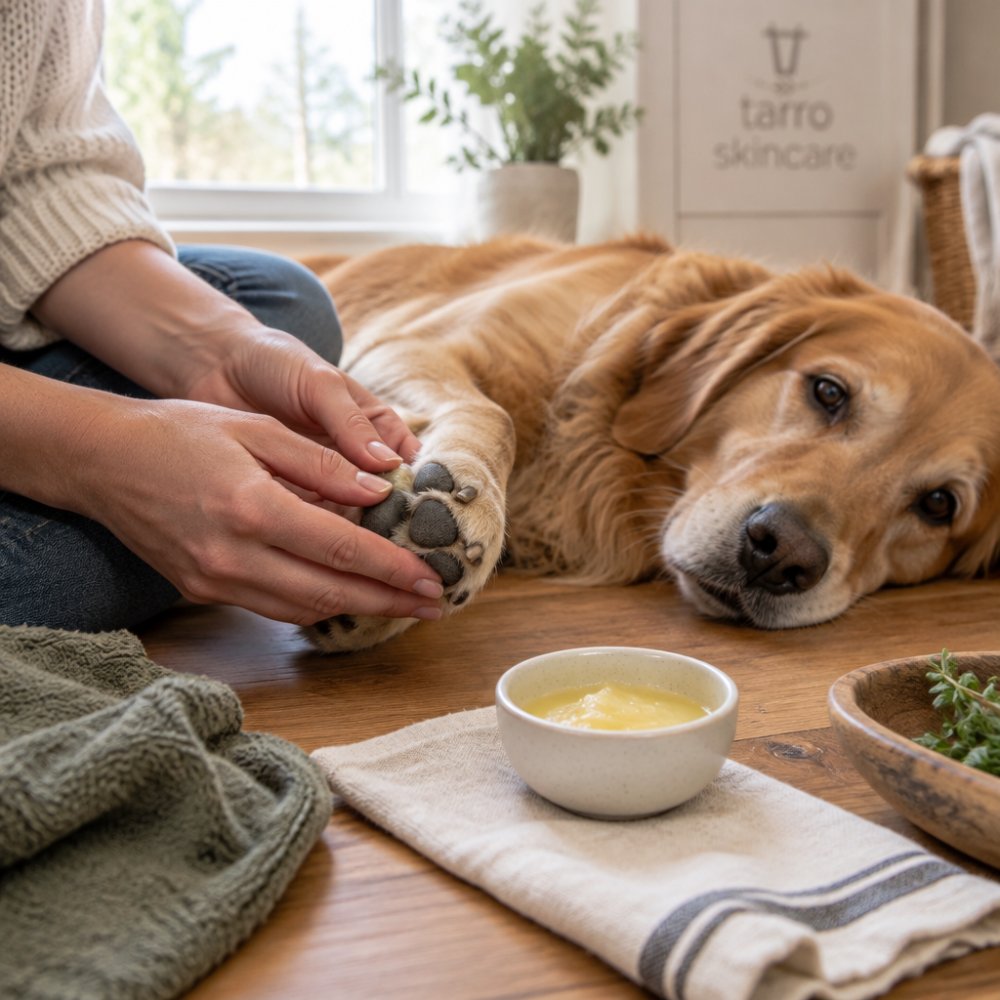
Follow these steps:
Bare Skin Balm | Fragrance-Free Grass-Fed Tallow Balm for Face and Body →
- Wipe paws with a damp cloth and dry them fully.
- Warm a pea-sized amount between your fingers.
- Massage into each pad and between the toes.
- Offer a treat or a short play session while it sinks in.
- Reapply two to three times a week, or daily in harsh weather.
A common mistake is applying balm right before a walk. It makes floors slippery and picks up grit. Apply after walks instead.
A DIY Dog Paw Balm Recipe You Can Make in One Pan
A reproducible farm-made balm needs weights, not scoops. The formula below makes approximately 135 g of finished balm, which fills about six 20 g tins or one 100 g tin plus a 35 g pocket tin. It is firm enough to survive a warm kitchen but soft enough to spread on a pad without dragging.
Equipment:
- Digital kitchen scale accurate to 1 g
- Heatproof glass jug or bowl
- Saucepan that the jug fits over (bain-marie)
- Silicone spatula
- Small tins or a balm bar mould, cleaned and dry
- Kitchen thermometer (optional but useful)
Ingredients by weight:
- 30 g beeswax pastilles or grated beeswax
- 60 g coconut oil (refined or unrefined; unrefined smells of coconut)
- 30 g shea butter
- 15 g olive oil
Method:
- Weigh the beeswax and shea butter into the jug. Set the jug over simmering water, ensuring the base does not touch the water.
- Heat gently until both are fully melted, stirring occasionally. Keep the water at a simmer, not a rolling boil.
- Add the coconut oil and olive oil. Stir until the mixture is uniform and clear, with no unmelted specks.
- Remove from the heat. Let it cool for two to three minutes, until it is warm rather than hot, then pour into tins or moulds.
- Leave to set at room temperature for at least two hours. Do not move the tins while setting, or the surface will be uneven.
Batch yield and cost: This makes roughly 135 g. At typical UK ingredient prices, the raw materials cost a few pounds per batch, far less per gram than a bought balm. Store the finished tins in a cool cupboard.
Texture troubleshooting:
- Too soft or greasy: add 5 g more beeswax and re-melt. Beeswax is the firming agent; small increments matter.
- Too hard or crumbly: add 5 g more olive oil or 5 g coconut oil and re-melt.
- Grainy: the shea butter was heated too quickly or too hot. Re-melt gently and stir until smooth.
- Setting unevenly: the room was too cold. Move the tins somewhere warmer while they set.
Seasonal adjustment: In a warm kitchen or summer, increase beeswax by 5-10 g for a firmer bar. In winter, reduce beeswax by 5 g so the balm stays spreadable. Keep a note of the exact weights that worked for your home so you can repeat the batch.
Watch out: never pour hot balm into plastic tubs that are not heat-stable, and never add water or aloe gel to a homemade balm unless you also add a preservative, water makes the balm a breeding ground for bacteria.
Storage, Shelf Life and Keeping It Clean
Store balm in a cool, dark cupboard in a sealed tin. Signs of spoilage include a sharp or paint-like smell, a change in colour, or a grainy, tacky texture that was not there before. Discard the tin if any of these appear.
Keep hands and paws dry before dipping. Never scoop with wet fingers, never share one tin between dogs, and never take a tin on a walk where it can pick up grit. If you want to use balm on the go, decant a small amount into a separate pocket tin rather than dipping into the main batch.
When Dry Paws Need a Vet, Not a Balm
Some paw problems need a vet, not a balm. Deep cracks that bleed, swelling, limping or a bad smell all point to something a balm cannot fix. So does a dog that constantly chews its paws.
Balm handles dryness and rough pads. It does not treat infection, allergies or foreign objects. The Blue Cross pet health advice recommends a vet visit for any paw issue that lasts more than a few days.
Choosing a Farm-Made Balm for Your Dog's Paws
A farm-made balm is only as good as its ingredients and its maker. Look for short ingredient lists, traceable sourcing and small-batch production. Ask where the fats and oils come from.
Our Good Doggy Natural Dog Balm is made with grass-fed tallow and nourishing oils to moisturise dry paws, noses and rough skin. It is handmade in small batches. You can also browse our full pet care range or read about where to find farm-made skincare in Britain. If you want to know who makes it, our about page tells the story.
| What to check | Why it matters |
|---|---|
| Short ingredient list | Fewer chances of irritation |
| Food-grade ingredients | Safer if licked |
| Traceable sourcing | You know what you are buying |
| Small-batch making | Fresher, more consistent balm |
Frequently Asked Questions
What can I put on my dog's dry paws?
These sit on the pad surface and slow moisture loss. Avoid human hand creams, which often contain fragrance, alcohol or urea. If the pads are cracked and bleeding rather than just rough, speak to your vet before applying anything.
Is natural paw balm safe for dogs if they lick it?
Distract them with a chew or a short game for ten minutes after application so it can absorb. Never use a balm containing tea tree, wintergreen, citrus essential oils in concentration, or zinc oxide. If your dog swallows a large amount and seems unwell, contact your vet.
How often should I apply balm to my dog's paws?
Increase to daily during cold snaps, after walks on gritted pavements, or when pads feel rough to the touch. Apply a thin layer rather than a thick one, and always after a walk rather than before, so the balm is not immediately worn off on tarmac. Wash and dry the paws first so you are not sealing grit against the skin.
Can I use human moisturiser on my dog's paws?
No. Human moisturisers frequently contain fragrance, essential oils, alcohol, urea or salicylic acid, none of which are suited to a dog that will lick its paws. A plain, unscented tallow or beeswax balm made for animals is the safer route. If you only have a human product to hand, check every ingredient against a dog-safe list first, and when in doubt, wait.
Dry, cracked paws will not fix themselves, and the wrong product can make things worse. Tarro makes small-batch balms with grass-fed tallow and simple plant oils, so you know exactly what goes on your dog's pads. Our balms are traceable, gentle and made for daily use. Get started with Tarro and give your dog comfortable, protected paws on every walk.


