

Is Tallow Balm Good for Your Skin Barrier?
Last Updated: November 20, 2026
Quick Summary
Tallow balm is good for your skin barrier in one specific way: it is an occlusive, water-free fat that slows moisture loss from the skin's surface. It is not a proven barrier repair treatment, as no high-quality human clinical trial has tested plain beef tallow as a moisturiser.
- Apply tallow balm as the last step of your evening routine using a pea-sized amount warmed between your fingertips.
- If your skin is oily or breakout-prone, use tallow as a body balm for heels and elbows, not a facial moisturiser.
- Patch test on the inner forearm for three nights before applying a new balm to your face.
- Judge a balm over two to four weeks by looking for less tightness, less stinging and fewer dry patches.
- Tarro's fragrance-free Bare Skin Balm costs £10.00 and is suited to dry skin needing an occlusive night step.
Is tallow balm right for your skin barrier?Traceable British grass-fed tallow balms, fragrance-free options, from £10.
Shop Tallow Balm
Table of Contents
- Is Tallow Balm Good for Your Skin Barrier? The Honest Answer
- What Tallow Balm Is and How It Is Made
- Fatty Acids, Skin Lipids and Barrier Function
- Does Beef Tallow Clog Pores? Comedogenicity and Breakouts
- Tallow Balm for Sensitive Skin: What to Check Before You Buy
- How to Use Tallow Balm on Your Face
- Tallow Balm vs Moisturiser: Which Suits Your Barrier?
- Choosing a Tallow Balm That Fits Your Routine
- Frequently Asked Questions
Is Tallow Balm Good for Your Skin Barrier? The Honest Answer
Tallow balm is good for your skin barrier in one specific way: it is an occlusive, water-free fat that slows moisture loss from the skin's surface. It is not a proven barrier repair treatment. A literature search through 2026 found no high-quality human clinical trial testing plain beef tallow as an everyday facial or body moisturiser, according to Scenic Dermatology's evidence review of beef tallow for skin.
That gap matters, and at Tarro we would rather you knew about it before you buy. Below, we break down what tallow actually does, who it suits, and how to tell whether a tallow balm belongs in your routine. The short version: it softens and protects dry skin well, and it is the wrong choice for oily or acne-prone skin.
What Tallow Balm Is and How It Is Made
Tallow balm is a water-free skincare product made from rendered beef fat, usually blended with plant oils and waxes.
Tarro only uses British grass-finished tallow, and ours is traceable right back to the farm. That traceability is worth asking about, because "grass-fed" is a farming claim, not a regulated skincare standard. If you are new to the ingredient, our guide on whether grass-fed tallow is good for your skin covers the background in more depth.
Fatty Acids, Skin Lipids and Barrier Function
The skin barrier is the outermost layer of skin, a lipid matrix of ceramides, cholesterol and fatty acids that holds water in and irritants out. Those three lipid classes do different jobs, and that distinction is where most tallow marketing quietly blurs the science.
The skin barrier is built from lipids including ceramides, cholesterol and fatty acids. Tallow, by contrast, is mostly triglycerides, a glycerol backbone carrying three fatty acids, plus small amounts of fat-soluble vitamins including vitamin A and vitamin E. Triglycerides are not the same molecule as a ceramide, and applying them does not directly replace barrier ceramides.
Here is where marketing outruns evidence. A 2025 paper reports that evidence supporting beef-tallow skincare claims remains insufficient, per the review of beef tallow claims in social media. One review found tested emulsions combining mutton tallow and walnut oil improved skin hydration, but that concerns blended emulsions, not plain tallow balm.
- Ingredient-level rationale, the observation that occlusives reduce transepidermal water loss and that fatty acids are barrier components. This is plausible and well established for occlusives generally, but it is reasoning about ingredients, not proof about a finished tallow balm.
- Laboratory and formulation studies, tests on blended emulsions or individual fatty acids. Useful for mechanism, limited for predicting how a plain balm performs on a face.
- Clinical trials, randomised, controlled human studies on the finished product. For plain beef tallow as a facial moisturiser, these are effectively absent.
- Expert opinion, dermatologists commenting on the trend, often cautiously. Valuable, but opinion.
- Anecdotal reports, social media and review evidence. The weakest tier, and the one most tallow marketing leans on.
What tallow reliably does is act as an occlusive and emollient: it sits on the surface, limits moisture loss and softens rough, dry skin. That is genuine comfort, not barrier repair. Short-term softness tells you the surface feels better; it does not demonstrate that the lipid matrix has been rebuilt. If you want to judge whether a product is helping your barrier rather than just coating it, look for reduced tightness after cleansing, less stinging when you apply a simple moisturiser, and fewer dry patches over two to four weeks, and treat a single good evening as no evidence at all. For a closer look at how lipids support the barrier, read our guide on supporting your skin lipid barrier naturally.
Does Beef Tallow Clog Pores? Comedogenicity and Breakouts
Rich occlusive balms can feel heavy on acne-prone skin, so it is worth testing carefully if your skin breaks out easily.
If your skin is oily or breakout-prone, treat tallow as a body balm for heels and elbows, not a facial moisturiser.
Tallow Balm for Sensitive Skin: What to Check Before You Buy
Fragrance is the first thing to check. "Natural" does not mean non-irritating, and essential oils are a leading cause of contact irritation in skincare. A fragrance-free formula removes that variable entirely.
Second, check the ingredient list length. A short list is easier to audit and easier to patch test against. Third, check the fat source and whether the maker will tell you the farm.
At Tarro, our formulation is done by a certified organic skincare formulator, and we do not use scare-mongering claims to sell our products. If your skin reacts to almost everything, patch test on the inner forearm for three nights before going near your face.
How to Use Tallow Balm on Your Face
Apply tallow balm as the last step of your evening routine, on cleansed skin, using a pea-sized amount warmed between your fingertips.
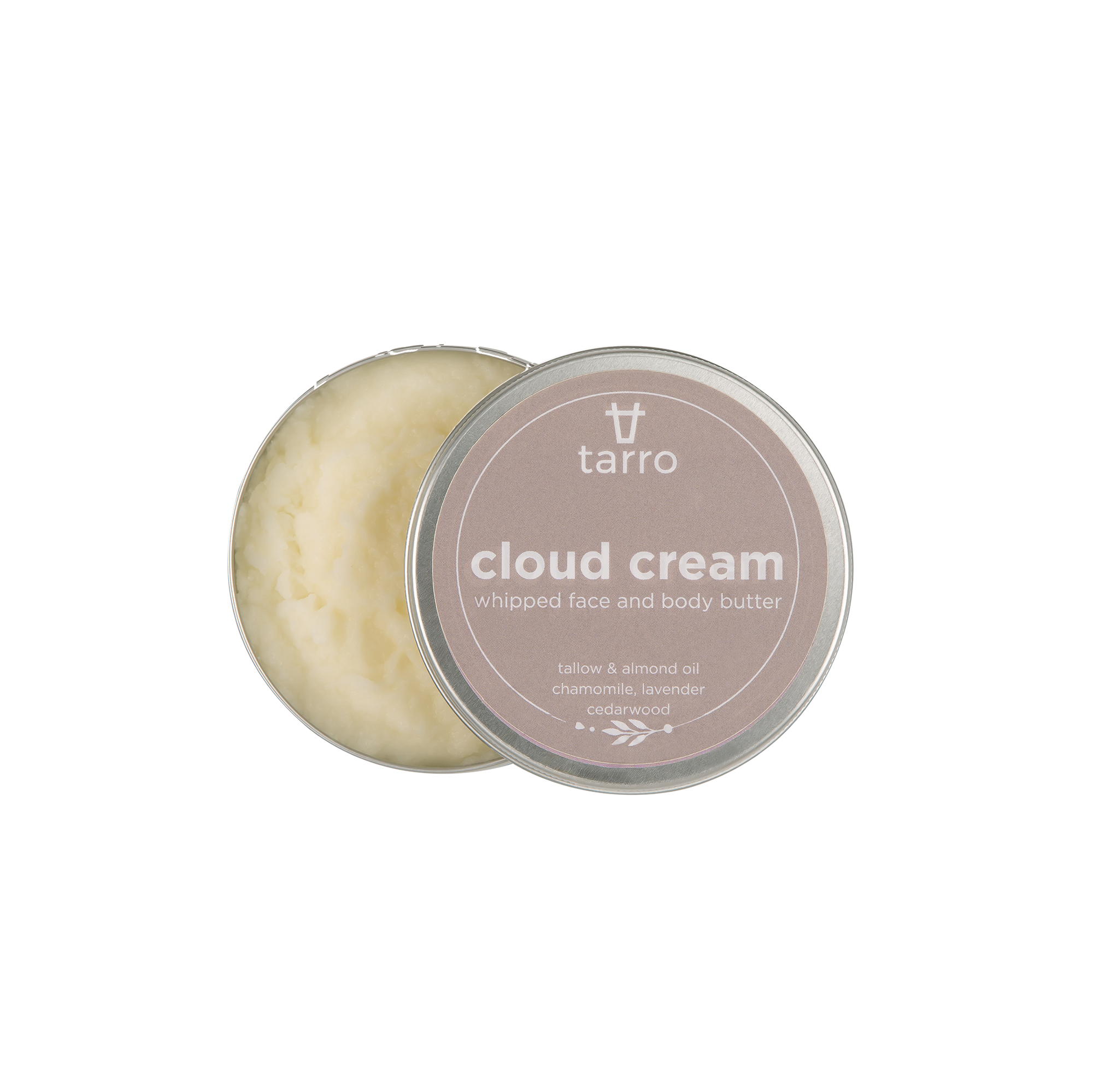
A little goes a long way, and a water-free balm will feel greasy if you over-apply. For dry, tight skin around the eyes, use a fingertip-sized amount and let it settle before bed. Our Cloud Cream whipped tallow night balm is built for exactly this evening step.
Tallow Balm vs Moisturiser: Which Suits Your Barrier?
A conventional moisturiser combines water, humectants and lipids, so it hydrates and softens in one step. A tallow balm contains no water at all, so it seals rather than hydrates. That is the whole difference at headline level, but the more useful question is what each product actually puts into the barrier, because that is where the two diverge sharply.
| Tallow balm | Ceramide-based barrier cream | Humectant-led water cream | |
|---|---|---|---|
| Main action | Occlusive seal, limits moisture loss | Replaces barrier lipids and occludes | Draws water into the upper layers |
| Key ingredients | Triglycerides, palmitic and stearic acids, some oleic acid, vitamin A and E | Ceramides, cholesterol, fatty acids, often petrolatum or shea | Glycerin, hyaluronic acid, sometimes niacinamide |
| Evidence for barrier repair | Ingredient-level rationale only; no clinical trials on plain tallow | Clinical trial evidence in dry-skin and eczema populations for several formulations | Good evidence for hydration; weaker for barrier repair alone |
| Best for | Dry, mature, weathered skin needing an occlusive night step | Dry, sensitive or eczema-prone skin with a compromised barrier | Most skin types, including oily, as a first layer |
| Acne-prone skin | Not recommended | Formulation-dependent; some are non-comedogenic | Usually better suited |
| Routine step | Last, at night | Last, morning or night | First, before an occlusive |
Tallow is an occlusive with a plausible but unproven barrier story, and it is best judged by its ingredients rather than by product category.
Humectant-led water creams add water-binding ingredients and feel light, and many routines pair them with an occlusive on top. A tallow balm can fill that occlusive role.
If your skin is oily or breakout-prone, treat tallow as a body balm for heels and elbows, not a facial moisturiser.
If your skin is dry and sensitive, a fuller comparison of tallow versus plant-based moisturisers will help you weigh them properly.
Choosing a Tallow Balm That Fits Your Routine
Match the balm to the job rather than buying a whole new routine. One balm, used consistently at night, is enough to judge whether tallow suits your skin.
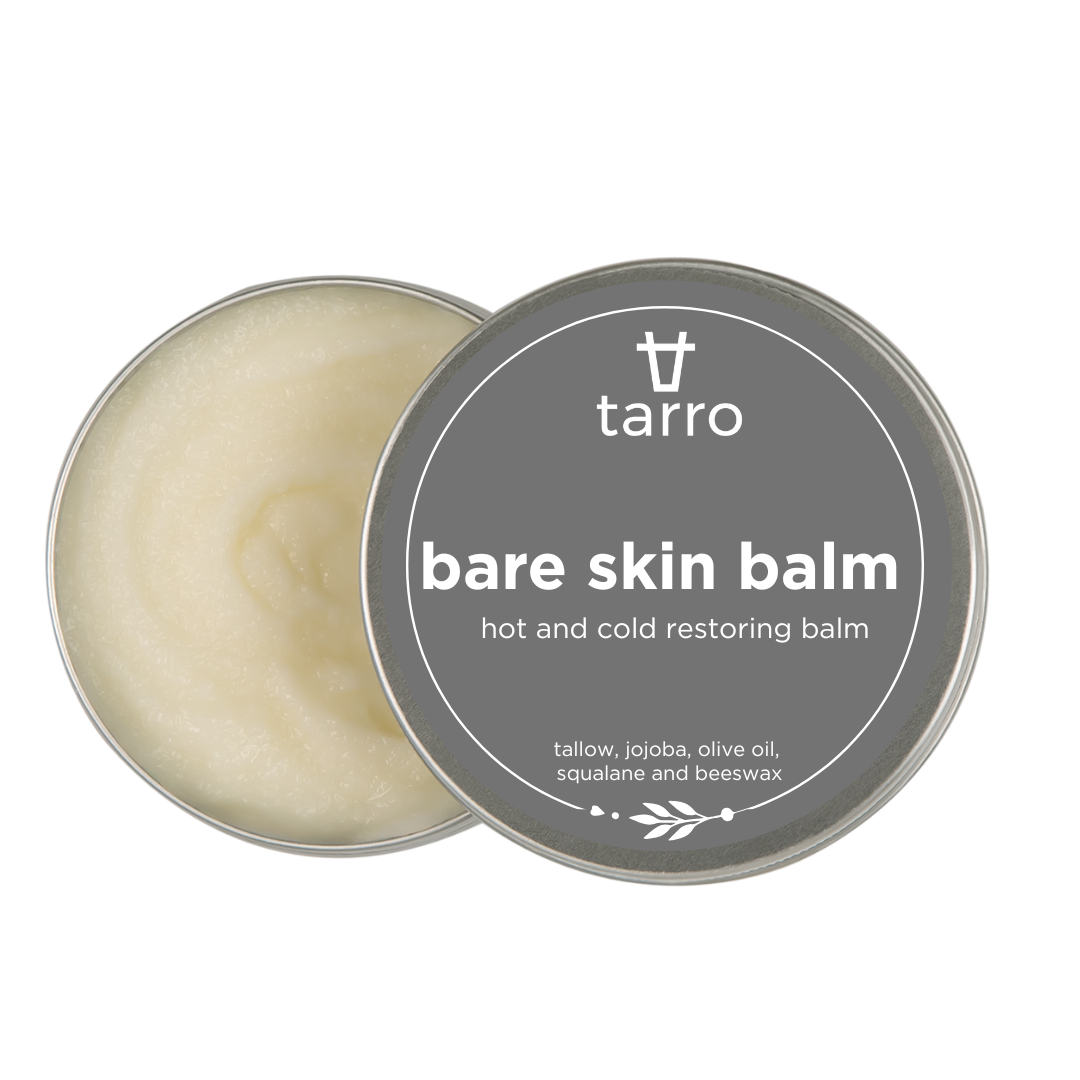
- Bare Skin Balm, £10.00 for face, body, hands and lips, fragrance-free and water-free, with jojoba, olive oil, squalane and beeswax. Suited to skin that feels dry after sauna, cold plunge, wild swimming or time outdoors.
- Calm Balm, £10.00 for dry, mature or sensitive-feeling skin, with just tallow, argan oil and vitamin E. Best for a minimal fragrance-free routine.
- Battle Balm, £10.00 for hands, elbows and heels. Best for rough, weathered skin, though it contains chamomile oil so it is not fragrance-free.
Best for: dry and mature skin that needs an occlusive night step. Skip if: your skin is oily, acne-prone or actively breaking out.
If you want to start with one product, shop the fragrance-free Bare Skin Balm and give it three weeks before adding anything else.
The honest challenge is this: most tallow balms are sold on claims the evidence cannot yet support, and that makes it hard to know what you are actually buying. We built Tarro around traceable British grass-finished tallow, lipid-rich water-free formulas, and a certified organic skincare formulator behind every batch, with recyclable and reusable packaging. No scare tactics, no miracle promises. Get started with Tarro and give your dry skin a simpler, more honest routine.
Frequently Asked Questions
Can tallow balm repair a damaged skin barrier?
No good evidence shows that plain tallow balm repairs a damaged barrier. Available evidence does not show that plain beef tallow has been tested in high-quality human clinical trials as an everyday moisturiser. What a water-free tallow balm can do is sit on the surface and limit moisture loss, which may help skin feel less dry and tight. If your barrier is genuinely damaged, patch testing first and speaking to a pharmacist or GP is sensible.
Does beef tallow clog pores?
Tallow is high in oleic acid, and rich occlusive balms can feel heavy on oily or acne-prone skin. Rich occlusive balms can feel heavy on acne-prone skin, so it is worth testing carefully. Not every user breaks out, but the risk is real enough to test carefully. Apply a small amount to one area for a week before using it across your face, and stop if you see new bumps or congestion.
Is tallow balm suitable for sensitive skin?
It can suit sensitive-feeling skin, but the formula matters more than the tallow itself. Fragrance-free options with short ingredient lists are the safer starting point, such as Tarro's Calm Balm, which contains only tallow, argan oil and vitamin E at £10.00. Avoid balms with essential oils if your skin reacts easily. Patch test on your inner forearm first, and remember that no ingredient is universally non-irritating.
How do you use tallow balm on your face?
Warm a pea-sized amount between your fingertips, then press it into cleansed skin rather than rubbing hard. Use it as the last step in your evening routine. A little goes a long way, and most tins should be used within 12 months of opening. Patch test first if your skin is reactive.
Is tallow balm better than a conventional moisturiser?
Not automatically. Conventional moisturisers often combine humectants that draw in water with occlusives that hold it there. A tallow balm is water-free and mostly occlusive, so it limits moisture loss rather than adding water to the skin. For very dry or weathered skin it can feel more comfortable; for oily or breakout-prone skin a lighter moisturiser usually suits better. Judge by your skin type, not by the trend.


