

How to Choose Mineral Sunscreen for Dry Sensitive Skin in 2026
Last Updated: November 4, 2026
Quick Summary
A mineral sunscreen for dry sensitive skin is a sun cream that uses zinc oxide or titanium dioxide filters, which sit on the skin's surface rather than being absorbed. Zinc oxide is often chosen for very reactive skin, and the base formula matters as much as the filter for dryness.
- Zinc oxide covers the full UVA and UVB spectrum and is largely inert on the surface.
- Titanium dioxide scatters visible light and can leave a chalky tint on deeper skin tones.
- Look for emollients such as squalane, ceramides, glycerin or shea butter in the base.
- Wait two to three minutes after moisturiser before applying sunscreen to avoid pilling.
- Check the full ingredient list, since a product labelled mineral can still contain fragrance or chemical filters.
Table of Contents
- What Mineral Sunscreen Is and Why It Suits Sensitive Skin
- Zinc Oxide Versus Titanium Dioxide: Which Filter Suits Dry Skin
- How to Repair Skin Barrier for Dry Skin Alongside Your Sunscreen
- Best Fragrance Free Moisturisers for Sensitive Skin Under Your SPF
- Sunscreen Application Tips for Dry Skin and Avoiding White Cast
- Reef Safety, Layering and Ingredients to Check on the Label
- Choosing Your Mineral Sunscreen Routine and Next Steps
- Frequently Asked Questions
What Mineral Sunscreen Is and Why It Suits Sensitive Skin
A mineral sunscreen is a sun cream that uses physical UV filters, most often zinc oxide or titanium dioxide, to sit on the skin's surface and reflect or scatter ultraviolet light. Unlike chemical filters, which absorb UV and convert it to heat, mineral filters do not need to be absorbed into the skin to work. That difference matters for anyone whose skin reacts to a long list of ingredients.
The market is growing quickly. Fortune Business Insights projects the global mineral sunscreen market to rise from USD 5.51 billion in 2026 to USD 15.35 billion by 2034 (Fortune Business Insights mineral sunscreen market report). Much of that demand comes from shoppers with sensitive skin, who make up the largest segment at roughly 31% of the market, according to the same report.
Dermatologists tend to recommend mineral formulas for reactive skin because the filters are photostable and sit on the surface, away from deeper skin layers (Doctor Rogers guide to dermatologist-recommended sunscreen). The trade-off has always been texture. Older mineral formulas could leave a white cast and feel thick. Newer ones are lighter, but a heavier feel is still common.
Zinc Oxide Versus Titanium Dioxide: Which Filter Suits Dry Skin
Both zinc oxide and titanium dioxide are used as UV filters in cosmetic sunscreens, and both can provide broad-spectrum protection when formulated correctly. The choice between them for dry, sensitive skin comes down to three practical differences: the range of UVA protection, the texture of the base they are suspended in, and how each behaves on reactive skin.
Zinc oxide covers the full UVA and UVB spectrum and is the filter most often chosen for very reactive skin because it is largely inert on the surface. Titanium dioxide is stronger against UVB and shorter-wave UVA, but it scatters visible light more aggressively, which is why it can leave a chalky tint on deeper skin tones unless the particles are micronised or coated. Micronising reduces the white cast but can shift the filter's behaviour, so formulators often coat the particles with silica or dimethicone to keep them dispersed and comfortable on dry skin.
For dry skin, the filter is only half the story. The base determines whether the sunscreen feels comfortable at 3pm or tight and flaky by lunchtime. A zinc oxide formula built on a lightweight silicone or oil base can still feel drying if it lacks emollients, while a titanium dioxide formula in a rich cream can feel occlusive. Look for a base that pairs the filter with squalane, ceramides, glycerin or shea butter, these either reinforce the skin's lipid barrier or hold water at the surface. Glycerin in particular is a humectant that draws water into the upper layers, which offsets the drying effect of the mineral particles themselves.
Neither filter is inherently better; the formulation decides the experience.
Sun Shield SPF 30 Mineral Sun Cream uses Zinc Oxide mineral UV filters with a blend of botanical oils, shea butter and hyaluronic acid. It is a lightweight cream designed to layer comfortably over skin. If your skin is very reactive, patch test a small area before applying to the face.
Watch out: a sunscreen labelled "mineral" can still contain chemical filters or fragrance in the base, check the full ingredient list, not just the front of the pack.
The two mineral filters differ in UVA coverage, how they look on the skin, and how they behave on reactive skin.
| Filter | Key difference | Note on reactive skin |
|---|---|---|
| Zinc oxide | Covers full UVA and UVB spectrum | Largely inert on the surface |
| Titanium dioxide | Stronger against UVB and shorter-wave UVA | Scatters visible light, can leave chalky tint |
| Micronised particles | Reduces white cast | Can shift the filter's behaviour |
| Coated particles (silica or dimethicone) | Keeps particles dispersed | More comfortable on dry skin |
How to Repair Skin Barrier for Dry Skin Alongside Your Sunscreen
Sunscreen helps protect skin from UV exposure, and it is not a barrier-repair product. Daily sun protection and barrier support work best together. If your skin is dry, tight or flaking, sunscreen alone will not fix the underlying problem.
Focus on gentle cleansing, a barrier-supporting moisturiser and consistent SPF. Avoid harsh exfoliants while the barrier is recovering. For a fuller look at the topic, read How Can You Support Your Skin Lipid Barrier Naturally? and How to Fix Dry Tight Facial Skin.
Best Fragrance Free Moisturisers for Sensitive Skin Under Your SPF
Fragrance is one of the most common triggers for sensitive skin, so a fragrance-free moisturiser is a sensible base under sunscreen. Bare Skin Balm is a fragrance-free, water-free tallow balm for face and body, with grass-fed British tallow, jojoba, olive-derived squalane and beeswax. It is available from £10.00 for the 30g size and suits skin that feels dry after time outdoors. Its short ingredient list makes it easy to check what you are applying.
Sun Shield SPF 30 Mineral Sun Cream →
Calm Balm is another fragrance-free option, made with grass-fed British tallow, argan oil and Vitamin E. It is handmade in Hertfordshire and costs £10.00. A little goes a long way.
If you want a balm with a light scent, Glow Skin Balm uses sweet orange essential oil and is formulated for dry, dull or mature skin. Because the scent comes from essential oils, skip it if you are avoiding fragrance entirely. Compare the full Tarro balm range to see which texture suits your routine.

Sunscreen Application Tips for Dry Skin and Avoiding White Cast
White cast on dry skin usually comes from three things: applying too much product in one go, applying over a moisturiser that has not fully absorbed, and using a formula whose particles are not well dispersed. Each has a practical fix.
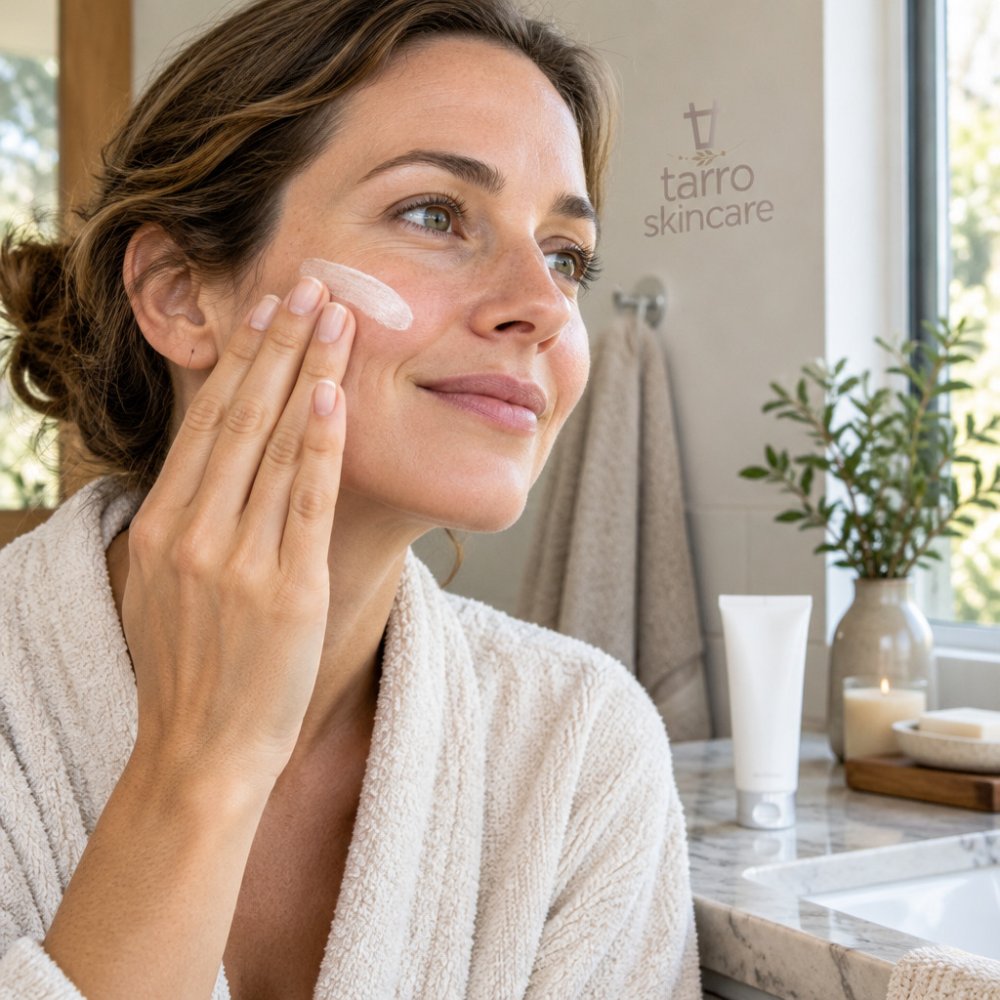
Start with the amount. Apply a generous amount, and consider applying it in two thin layers rather than one thick one so each layer can settle before the next. Warm the first layer between your fingertips and press it into the skin rather than rubbing, pressing helps the mineral particles sit evenly instead of collecting in dry patches.
Layering order matters more for dry skin than for any other type. Cleanse, apply any water-based serum, then moisturiser, then sunscreen. Wait two to three minutes between the moisturiser and the SPF so the moisturiser has absorbed. Applying sunscreen over pooled or tacky moisturiser is the most common cause of pilling, where the product rolls into little balls and leaves bare patches. If your moisturiser is a heavy balm or occlusive, use a thinner layer under the SPF or switch to a lighter moisturiser in the morning and save the balm for night.
For days outdoors, reapply regularly, particularly after swimming or heavy sweating.
For a practical starting point, Sun Shield SPF 30 Mineral Sun Cream is designed for daily wear and layers comfortably over moisturiser.

Reef Safety, Layering and Ingredients to Check on the Label
When layering, keep the order simple: cleanser, serum if you use one, moisturiser, then SPF. Avoid stacking multiple heavy occlusives under your sun cream, as this can make it harder for the mineral filters to sit evenly.
On the label, look for zinc oxide or titanium dioxide listed as the active filter, a broad-spectrum claim, and an SPF of at least 30. Check for fragrance if your skin is reactive, even when the product is marketed as gentle.
Choosing Your Mineral Sunscreen Routine and Next Steps
Start with a fragrance-free moisturiser, a zinc oxide sunscreen with an SPF of 30 or higher, and a patch test on a small area of skin for several days. If your skin tolerates both, add the rest of your routine gradually.
Dry sensitive skin usually improves when you keep the routine short and consistent. Tarro's balms and Sun Shield SPF 30 are a practical place to start, and you can browse the full Tarro range when you are ready to build out your routine.

Frequently Asked Questions
Is mineral sunscreen better for dry sensitive skin?
For many people with dry or reactive skin, mineral sunscreen can be a sensible starting point because zinc oxide and titanium dioxide sit on the skin's surface rather than being absorbed. The trade-off is that some formulas feel thicker or can leave a white cast. Look for a moisturising base, check the ingredient list for fragrance and test a small area first before applying it to the whole face.
Does mineral sunscreen dry out your skin?
Not inherently. Mineral filters themselves do not strip moisture, but a formula's base can determine how the skin feels through the day. Sunscreens built with humectants such as hyaluronic acid, aloe vera and skin-conditioning oils are better suited to dry skin than matte, alcohol-heavy formulas. If your skin tightens after application, moisturise underneath with a fragrance-free balm or cream and let it settle before you apply your SPF.
Can I use tallow-based skincare alongside mineral sunscreen?
Yes. Many people with dry skin layer a fragrance-free tallow balm under their SPF to support the skin's natural lipid barrier. Apply the balm to clean, slightly damp skin, allow a few minutes to absorb, then apply sunscreen as the final step. Sun Shield SPF 30 Mineral Sun Cream is a daily option at £25.00 for a 50ml tube, and Calm Balm at £10.00 can sit underneath it for extra softness.
How do I prevent mineral sunscreen from looking chalky on dry skin?
Use less than you think you need and warm the cream between your fingertips before pressing it into the skin. Thin layers blend more easily than one heavy application. Let the first layer settle for a couple of minutes, and make sure your moisturiser underneath is fully absorbed, because a tacky base encourages pilling and white cast. Blend outwards from the centre of the face to avoid visible patches.


