

Benefits of Tallow for Mature Skin: A Complete Guide
Table of Contents
- Why Tallow Suits Mature Skin
- The Benefits of Tallow for Mature Skin
- Tallow for Dry Skin and Age-Related Dryness
- Tallow Moisturiser for Wrinkles and Fine Lines
- How to Use Beef Tallow on Face
- Tallow Skincare Risks and Who Should Avoid It
- Choosing a Quality Tallow Balm
- Frequently Asked Questions
Last Updated: October 19, 2026
Why Tallow Suits Mature Skin
Mature skin loses moisture faster because sebum production declines with age, and tallow for mature skin works by replacing some of that lost lipid content with a fat profile close to the skin's own. At Tarro, we render grass-fed British tallow into balms precisely because this compatibility matters more after 40 than it did at 25.
What Tallow Is and How It Is Made
Tallow is rendered fat from cattle, typically suet, that has been gently heated and filtered to remove impurities. Rendering separates the pure fat from connective tissue and water, leaving a firm, shelf-stable solid at room temperature. Grass-fed tallow carries a slightly golden tone and a mild, earthy scent; heavily processed versions are white and odourless but lose some of the trace nutrients in the process.
How the Fatty Acid Profile Compares to Skin
Human sebum is built largely from oleic, palmitic and stearic acids, and tallow contains the same trio in broadly similar proportions. That overlap is the whole argument for tallow skincare: the skin recognises the lipids and integrates them into the barrier rather than sitting on top of them. It is not a perfect match, and no fat is, but it is closer than most plant oils, which tend to be richer in linoleic acid.
The Benefits of Tallow for Mature Skin
The benefits of tallow for mature skin come down to two things: it slows moisture loss, and it supplies fat-soluble vitamins the barrier uses. It is not a treatment for wrinkles or a substitute for prescribed actives. Think of it as the emollient layer that makes everything else work better.
Moisture Retention and Barrier Support
Tallow is an occlusive emollient. Applied to damp skin, it forms a breathable film that reduces transepidermal water loss, the process by which water escapes through the outer layer. For skin that has thinned with age, that film is doing real work. A common mistake is applying balm to dry skin; it seals in nothing and feels greasy for hours. Mist or dampen first, then press the balm in.
Vitamins and Nutrients in Tallow
Grass-fed tallow naturally contains small amounts of vitamins A, D, E and K, though the levels vary by animal diet and rendering method and are not standardised. Vitamin A supports normal skin cell turnover, while vitamin E acts as an antioxidant. These are supporting players, not a retinol alternative. If you want a measurable vitamin A effect, you need a formulated retinoid.
Tallow for Dry Skin and Age-Related Dryness
Age-related dryness is not the same as a temporary dry patch. As oil production falls, skin struggles to hold water, and tightness around the eyes and cheeks becomes a daily sensation rather than an occasional one. Tallow for dry skin suits this pattern well because it replenishes lipids rather than just adding water.
Tallow Moisturiser for Wrinkles and Fine Lines
A tallow moisturiser will soften the look of fine lines by plumping the outer layer of skin with moisture, and that effect is real, visible and temporary. What it will not do is rebuild collagen, reverse sun damage or erase lines that have formed over decades. The marketing around natural skincare often blurs that line, so it is worth being precise about what the evidence supports and what it does not.
What is established
Occlusive and emollient moisturisers, the category tallow belongs to, reliably reduce transepidermal water loss and improve the appearance of dry, flaky and crêpey skin. That is well accepted in dermatology and is the basis on which emollients are recommended for dry skin conditions. When the outer layer is hydrated, fine lines look less pronounced within hours, and consistent moisturising helps skin look smoother over weeks.
What is not established
There is no robust clinical evidence that tallow itself stimulates collagen, reduces wrinkle depth in the way a retinoid does, or reverses signs of ageing. Tallow contains small, variable amounts of vitamins A, D, E and K, but the levels are not standardised, are not present in the concentrations used in formulated retinoid products, and are not a substitute for a prescribed or over-the-counter retinoid.
Where tallow genuinely fits an anti-ageing routine
The useful role for tallow in mature skin is as the occlusive final step that makes evidence-based actives easier to tolerate.
A practical order for an evening routine is: cleanse, apply your retinoid or active to dry skin, wait a few minutes, then press a pea-sized amount of tallow over the top.
Setting realistic expectations
Expect softer, more comfortable, better-hydrated skin within days. Expect fine lines to look less obvious while skin is well moisturised. Do not expect deep lines, laxity or sun damage to change because of tallow. If wrinkle reduction is your priority, speak to a pharmacist or GP about evidence-based options, and treat tallow as the comfort layer that supports them rather than the treatment itself.
Key Takeaway
Tallow is a good moisturiser, not an anti-ageing treatment. Use it to make proven actives tolerable and consistent, and keep sunscreen and retinoids at the centre of your routine.
How to Use Beef Tallow on Face
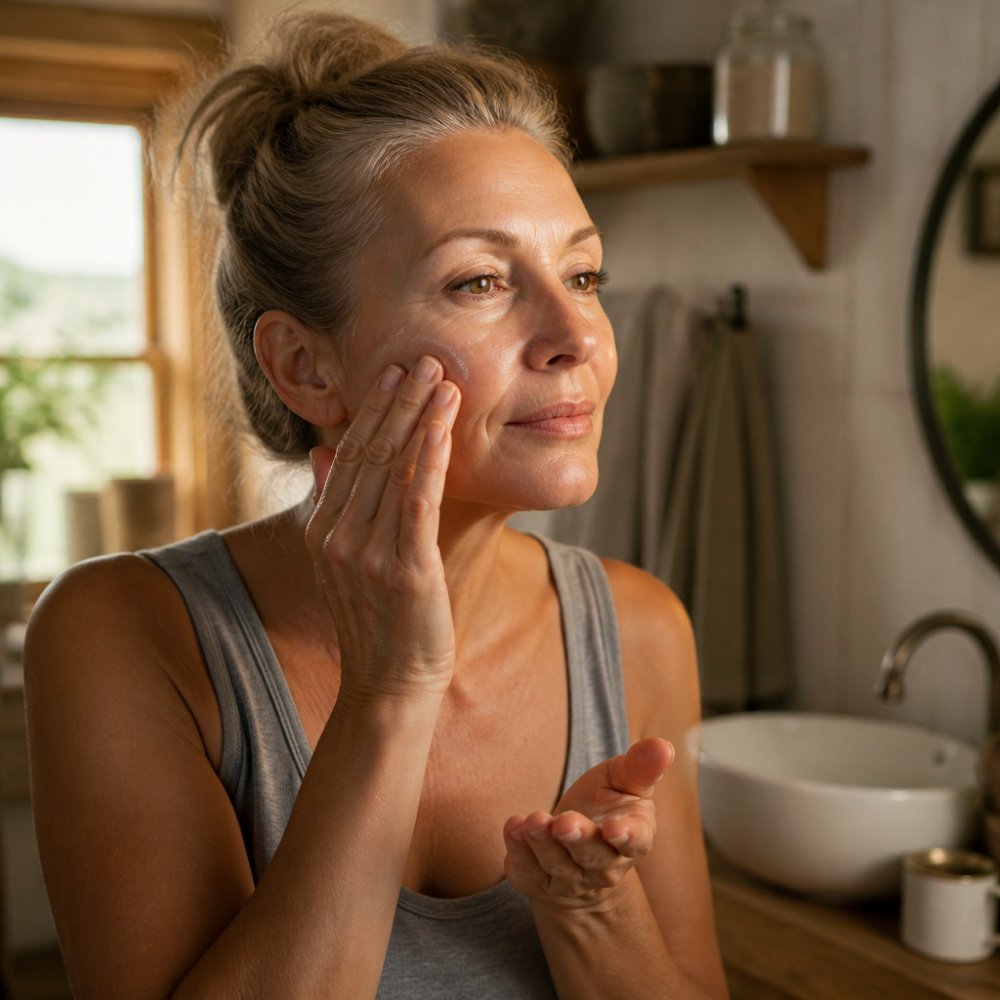
Here is the routine we recommend, and it takes under two minutes.
- Cleanse with a mild, non-foaming cleanser and pat skin until slightly damp.
- Warm a pea-sized amount of balm between fingertips until it melts.
- Press, do not rub, into face and neck, working outward and upward.
- Use morning and evening; reduce to evening only if skin feels heavy.
- Patch test on the inner forearm for 48 hours before first facial use.
Pro Tip
If your skin feels greasy rather than comfortable, you are using too much. A pea-sized amount covers the whole face; the greasiness is nearly always a dose problem, not a formula problem.
Tallow Skincare Risks and Who Should Avoid It
Tallow is a rich, occlusive animal fat, and that richness is exactly why it does not suit every mature skin type. Most practitioners find that the people who react badly to tallow balms are not reacting to the tallow itself but to something else in the tin, a fragrance, an essential oil, or a botanical extract added to make the product smell nicer.
Irritation and allergy
A genuine allergy to beef tallow is uncommon but possible, and anyone with a diagnosed cow's milk protein allergy should treat tallow skincare with caution and speak to their GP before using it. More often, irritation comes from added ingredients. Essential oils such as lavender, chamomile and citrus are common sensitisers, and mature skin that has become more reactive over time is less forgiving of them than it was at 25.
Acne-prone and oily mature skin
Mature skin is not automatically dry skin. If you are over 40 and still get breakouts along the jaw, chin or back, a heavy tallow balm may be too occlusive for those areas. Oleic acid, one of the main fatty acids in tallow, is generally considered more comedogenic than linoleic acid, which dominates in lighter plant oils such as rosehip and safflower.
Broken skin, active flares and infection risk
Do not apply a rich balm over active eczema, psoriasis plaques, broken skin, a fresh breakout or a recent facial treatment such as microneedling or a chemical peel. An occlusive film can trap heat, bacteria and irritants against compromised skin and make a flare worse. Wait until the skin has settled, then reintroduce tallow gradually. If you have a diagnosed skin condition, run any new occlusive product past your GP or a dermatologist first.
Contamination and product hygiene
Tallow is a fat, and fats go rancid. Wide-mouthed jars that you dip fingers into introduce bacteria and moisture with every use, and a balm that smells sharp, waxy or "off" should be discarded even if it is within its best-before date. Choose aluminium tins or glass jars with a narrow opening, use a clean spatula rather than fingers where possible, keep the tin out of direct sunlight and away from a hot bathroom windowsill, and store it cool.
When to stop using it
Stop and speak to a pharmacist or GP if you notice spreading redness, swelling, itching that worsens with each application, a rash that appears within 48 hours of first use, or any sign of infection such as warmth, pus or increasing pain. Mild transient tingling is not unusual on very dry skin, but burning, stinging that persists, or a flare that gets worse rather than better over a week are signals to stop.
Patch testing, properly
Patch test every new balm, even a two-ingredient one, and even if you have used tallow before. Apply a small amount to the inner forearm, cover it lightly, and leave it for 48 hours without washing the area. Check at 24 and 48 hours for redness, swelling or itching. If there is no reaction, repeat on a small area of the jawline for a further three to five days before using it on the full face.
Watch Out
Do not apply a rich balm over an active flare, broken skin or a fresh breakout. The occlusive film can worsen irritation by trapping heat and bacteria against compromised skin.
Pro Tip
If a scented balm irritates your skin, do not assume tallow is the problem. Switch to an unfragranced, short-ingredient formula and patch test again before giving up on the ingredient altogether.
Choosing a Quality Tallow Balm
Quality comes down to four things: the source of the fat, the full ingredient list, the packaging, and whether the maker tells you where the tallow came from.
| What to check | Good sign | Red flag |
|---|---|---|
| Fat source | Named farm or region | "Grass-fed" with no origin |
| Ingredient list | Five ingredients or fewer | Long list, hidden fragrance |
| Packaging | Aluminium tin or glass | Open jar, no date |
| Scent | Mild, natural | Strong perfume |
| Price | £10-£20 per 30-80g tin | Suspiciously cheap |
Our Calm Balm is a two-ingredient tallow and argan formula at £10.00, fragrance-free and suited to dry, mature or easily irritated skin, which makes it the simplest starting point if you are unsure how your skin will respond.

Frequently Asked Questions
Is beef tallow good for older skin?
Tallow is rich in oleic, palmitic and stearic fatty acids that mirror the lipids found in human sebum, so it can sit comfortably on mature skin that has lost some of its natural oil production. It works as an occlusive moisturiser, slowing moisture loss and supporting the skin barrier. It is not a treatment for wrinkles or a replacement for retinoids, but many people with dry or barrier-impaired skin find it softening and comfortable. Patch test first if your skin is sensitive.
Can beef tallow help with wrinkles?
No topical moisturiser removes wrinkles, and tallow is no exception. What a tallow moisturiser for wrinkles can do is keep the skin surface hydrated, which temporarily plumps the look of fine lines and makes them appear softer. It also supports the barrier, which helps skin recover from dryness and irritation. For visible changes to lines over time, pair tallow with evidence-based actives such as retinoids and daily sun protection.
Can tallow clog pores or cause breakouts?
Tallow is a rich, occlusive ingredient, so it can feel heavy on oily or acne-prone skin and may contribute to congestion in some people. Mature skin is usually drier and tolerates richer textures better. If you are prone to breakouts, use a small amount, apply it to dry areas only, and stop if you notice new spots. Patch testing on the jawline for a few nights before applying to the full face is a sensible step.
How do you use tallow moisturiser on mature skin?
Cleanse gently, then apply a small amount of tallow balm to slightly damp skin so it seals in water. Warm a pea-sized amount between your fingertips and press it into the face and neck rather than rubbing hard. Use it as the final step in your evening routine, after any serums or retinoids. In the morning, a lighter layer works well, or use it only on dry patches. A 30g tin typically lasts several weeks.
Mature skin deserves a moisturiser that does one job properly rather than ten jobs badly. If you want a lipid-rich balm with a traceable ingredient list and nothing hiding in the formula, start with a patch test and a single tin. Browse the Tarro range and add a balm to your cart to see how a short, honest ingredient list feels on skin that has earned a gentler routine.


